
How Often Are PAT Tests Required? PAT testing frequency in the UK is risk-based rather than fixed. Most portable appliances are inspected about once a year, with higher‑risk items and frequently handled tools checked every 6–12 months. Low‑risk or permanently connected equipment may only need visual checks and periodic inspections. Employers must assess the environment, use and user competence to set intervals and keep records. Tenanted properties often follow tighter schedules. Further guidance and examples explain how to apply these principles.
Key Takeaways
- There is no legal fixed frequency; test intervals should be set by a documented risk assessment.
- Most portable appliances are tested annually, but high-risk items need checks every 6–12 months.
- Low-risk or permanently connected equipment may only need regular visual inspections, not frequent PAT tests.
- Landlords and HMOs should usually test furnished properties and communal appliances every 6–12 months.
- Keep written records of inspections, tests, faults, and who carried them out to demonstrate compliance.
Table of Contents
Quick Answer: How Often Should PAT Testing Be Done?
How often PAT testing should be carried out depends on the type of equipment, its usage and the environment in which it operates; general guidance recommends annual testing for most portable appliances, more frequent checks for high-risk or frequently moved items, and extended intervals or visual inspections only for low-risk, permanently connected equipment. A concise approach categorises items: handheld tools and kettles often need testing every 6–12 months; office equipment, such as computers and printers, typically every 12–48 months; and stationery items may be subject to less frequent formal testing if regular visual inspections occur. High-use, harsh-environment, or consumer-facing equipment warrants shorter intervals and documented inspections.
How Often Are PAT Tests Required? Employers and duty holders are advised to implement risk-based schedules, keep records of results and remedial actions, and guarantee competent persons carry out or oversee inspections. Clear, proportionate planning balances safety, practicality and cost without implying fixed statutory intervals for all appliances. Here is the detailed guidance on What Is a Portable Appliance Test (PAT)? Importance, Process, and Benefits Explained.

What the Law Requires for PAT Testing in the UK
Having established recommended PAT intervals based on risk and usage, attention now turns to the legal framework governing portable appliance testing in the UK. The law does not prescribe fixed PAT frequencies; instead, it requires that employers and duty holders guarantee electrical equipment is maintained so as to prevent danger. This duty arises from the Electricity at Work Regulations 1989 and HSE guidance. Visual inspection, routine maintenance, and testing should be proportionate, documented, and acted upon. Records and remedial actions demonstrate compliance.
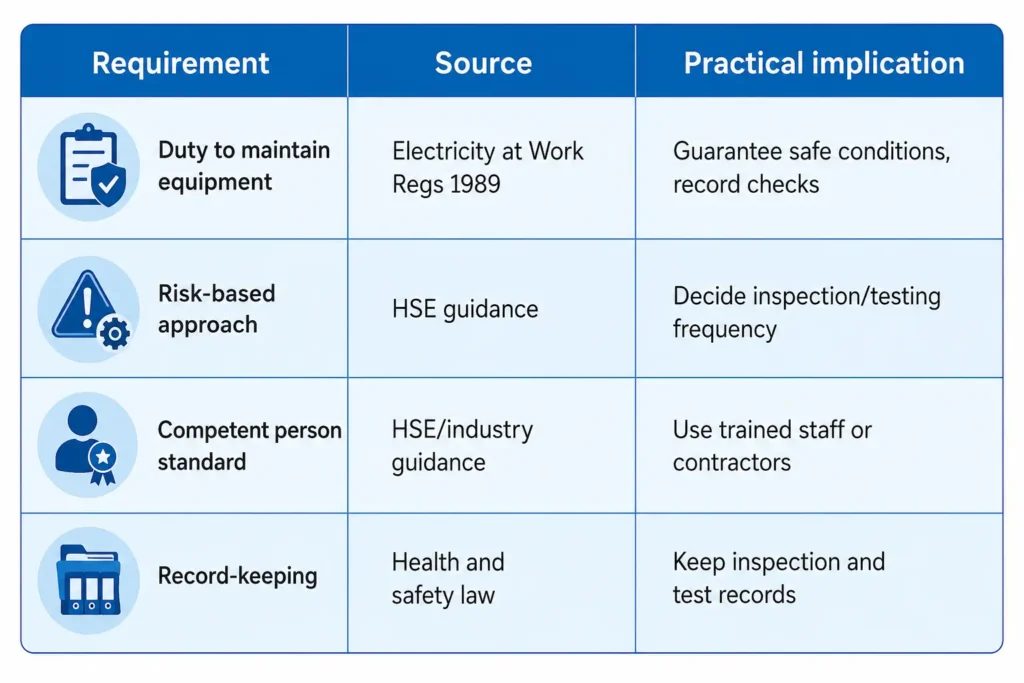
Ultimately, legal compliance means evaluating risk, applying suitable inspection/testing, remedying faults, and keeping evidence of those actions. Read our blog post Is PAT Testing a Legal Requirement for Landlords and Businesses? to learn more about compliance.
Risk & Environment: Deciding PAT Frequency
Because risk and environment shape the likelihood of electrical faults, determining PAT frequency requires evaluating where equipment is used and how it is handled. The assessment considers factors such as physical conditions (moisture, dust, vibration), user competence, duration and intensity of use, and the consequences of failure. Higher-risk settings, such as construction sites, industrial workshops, or busy commercial kitchens, warrant more frequent inspection and testing than low-risk offices or domestic-like environments.
Decisions typically balance visual inspections, routine functional checks by responsible persons, and formal PAT testing by competent technicians. Portable items subjected to rough handling or outdoor exposure may need testing every few months, whereas office equipment might be assessed annually or biennially. Critical items that present significant danger of failure should be prioritised and tested more often. Records of inspections, any remedial actions, and contextual notes about operating conditions support informed, proportionate scheduling and demonstrate a defensible safety approach.
Portable vs Fixed Appliances: Testing Rules
What distinguishes portable from fixed appliances for PAT purposes is their mobility and connection type: portable appliances are intended to be moved and usually plug into a socket, while fixed appliances are permanently connected to the electrical installation or hard-wired in place. The distinction affects inspection scope and testing approach. Portable appliances typically undergo visual inspection, earth continuity, insulation resistance and functional checks; fixed appliances often require inspection of installation integrity, fixed wiring, and appropriate protective devices.
Responsibility for testing frequency follows risk assessment and dutyholder decisions, with emphasis on usage, environment, and the consequences of failure. Competent testers apply appropriate test limits and record results for both types, noting that some fixed equipment may be covered by periodic electrical installation inspections rather than conventional PAT routines. Clear documentation guarantees that follow-up actions and schedules align with safety priorities.
PAT Intervals for Common Workplaces (Offices, Factories, Construction)
After distinguishing portable and fixed appliances and how their testing is carried out, attention turns to typical PAT inspection intervals across different workplace environments. Offices, with relatively low-risk equipment and stable conditions, commonly adopt an annual visual check and combined inspection every 2–4 years for general appliances; IT equipment and double-insulated devices often follow longer intervals owing to lower risk.
Factories present harsher conditions: dust, vibration and heavy use justify more frequent checks. Many operators schedule visual inspections monthly or quarterly and formal PAT every 6–12 months, with high-risk machinery inspected more often. Construction sites represent the highest exposure to damage, moisture and rough handling; equipment brought onto site usually requires pre-use visual checks and formal testing at the shortest practicable intervals, often before each project stage or at monthly to three-monthly cycles. Employers should assess risk, record decisions, and adjust intervals based on equipment condition, environment and usage patterns rather than relying on fixed legal timelines.
PAT for Landlords: Rental Property Testing Schedules
How frequently portable appliance testing should be carried out in rental properties depends on risk, tenancy type and landlord responsibilities. Landlords should adopt a risk-based approach: higher turnover or furnished tenancies with multiple appliances need more frequent PAT, while long-term unfurnished lets may require less. Local regulations and tenancy agreements influence expectations, and documented inspection schedules demonstrate reasonable care.
- Furnished or HMO properties: test every 6–12 months due to shared use and varied appliance condition.
- Standard rented homes with landlord-supplied appliances: test every 1–3 years, adjusting for appliance age and usage.
- New or rarely used properties: initial test on change of tenancy, then schedule based on found defects and risk assessment.
Records of testing dates, results and remedial actions should be kept. Where uncertainty exists, landlords are advised to consult a qualified PAT contractor or seek guidance from local authorities to guarantee compliance and tenant safety.
Daily and Pre-Use Visual Checks Between PATs
Between scheduled PAT inspections, landlords and tenants should rely on daily and pre-use visual checks to identify obvious faults that could pose immediate risk. These checks are simple, non-technical examinations aimed at spotting damage, overheating, exposed wiring, broken plugs, loose connections, damaged insulation, or scorch marks. Users should inspect cables, plugs, switches and appliance housings before each use and report or isolate any suspect item.
Checks do not replace formal PAT testing but act as a first line of defence to prevent injury or fire. If an appliance shows physical damage, unusual noise, smell, or excessive heat, it should be unplugged and taken out of service until a qualified person assesses it. Landlords may instruct tenants on what to look for and require prompt reporting of faults. Clear records of reported faults and actions taken support safety and help prioritise formal testing or repair without attempting technical repairs beyond simple isolation and reporting.

Set Up a Compliant PAT Programme, Records, and When to Hire a Tester
Establish a PAT programme by defining responsibilities, testing intervals, recordkeeping procedures, and escalation paths so that landlords and facility managers can consistently demonstrate due diligence. The programme should document appliance inventories, risk-based testing frequencies, and who is authorised to carry out visual inspections and formal testing. Clear records of test dates, results, remedial actions, and asset identifiers enable trend analysis and audit readiness.
When to hire a qualified PAT tester depends on in-house capability and risk: complex equipment, high-risk environments, or lack of trained staff necessitate external competence. An accredited tester brings calibrated instruments, up-to-date standards knowledge, and liability cover. Prioritise retention and accessibility of records; store digital copies with backups, and retain records for a minimum period aligned with organisational policy or landlord obligations.
- Assign ownership and a review cadence.
- Maintain searchable test and repair logs.
- Engage a certified tester for high-risk or non-routine inspections.
Frequently Asked Questions
Can PAT Testing Detect Internal Electronic Faults in Modern Appliances?
Yes, it can detect some internal electronic faults. The tester identifies insulation failures, earth continuity issues and leakage currents, but complex component faults or intermittent software/hardware failures often require specialist diagnostic equipment beyond standard PAT testing.
Are PAT Testers Regulated or Required to Have Certification in the UK?
Yes. In the UK, PAT testers are not legally required to hold statutory certification, but competent persons should be trained and competent; many employers expect accredited courses (e.g., City & Guilds) and documented training for liability and safety assurance.
How Long Do PAT Test Labels and Certificates Need to Be Kept?
Records and labels should be retained for as long as necessary to demonstrate maintenance and safety; typically at least five years for certificates and until equipment is disposed of, with test labels remaining on items while in service.
Do Battery-Powered Devices Need Different PAT Procedures?
Yes. They require visual inspection and appropriate leakage/charge checks; removable batteries may be tested separately. Test methods adapt to low-voltage risks, with insulation and construction assessments rather than a high-voltage earth continuity emphasis.
Can Non-Electric Landlords Perform PAT Visual Inspections Themselves?
Yes. The landlord can perform visual PAT inspections themselves, provided they are competent to identify obvious damage, loose connections, or exposed wiring; however, formal testing should be carried out by a qualified person when required.
Conclusion
In conclusion, how often are PAT Tests Required? PAT testing frequency in the UK depends on risk, environment and appliance type rather than a fixed legal interval. Employers and landlords must ensure equipment is safe through a combination of visual checks, formal inspections, and testing tailored to workplace conditions. Records and a documented programme help demonstrate compliance; higher-risk settings require more frequent testing while low-risk environments need less. When in doubt, consult a competent, qualified tester to establish an appropriate schedule.