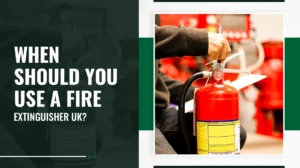

Knowing when should you use a fire extinguisher UK is an important part of fire safety in homes, workplaces, shops, offices, HMOs, commercial buildings and other premises. A fire extinguisher can be useful for tackling a small fire during its early stages, but using one at the wrong time can expose you to heat, smoke, toxic gases and rapidly spreading flames.
A fire extinguisher should never be regarded as the first priority when a fire occurs. The immediate priorities are to raise the alarm, warn other people, begin evacuation and contact the fire and rescue service where necessary. An extinguisher should only be considered where the fire is small and manageable, the correct type of extinguisher is available, the person using it knows how to operate it and there is a clear escape route behind them.
UK government guidance states that portable fire extinguishers should be suitable for the risks present and easily accessible. It also emphasises that employees should understand the circumstances in which they should not attempt to tackle a fire. If there is any doubt, people should raise the alarm, leave the premises and contact the fire and rescue service.
The decision to use an extinguisher therefore depends on the size and type of fire, the surrounding conditions, the available escape route, the extinguisher provided and the competence of the person attempting to use it.
Key Takeaways
- Use a fire extinguisher only on a small fire that is in its early stages.
- Raise the alarm before attempting to tackle the fire.
- Make sure the extinguisher is suitable for the type of fire.
- Always keep a clear escape route behind you.
- Never allow the fire to place you between itself and your exit.
- Do not attempt to fight a fire involving heavy smoke or rapidly spreading flames.
- Untrained people should not be expected to tackle fires.
- Do not use water on electrical equipment or ordinary flammable liquid fires.
- Cooking oil and fat fires require suitable Class F firefighting equipment.
- If you are unsure whether it is safe, evacuate and call 999.
- Fire extinguishers are a first aid firefighting measure and are not a substitute for evacuation or professional firefighting.
Table of Contents
When Should You Use a Fire Extinguisher?
A fire extinguisher should be considered when a fire is small, contained and in its early stages, and when using the extinguisher will not put you or anyone else in danger.
For example, a small fire involving a waste bin, a limited area of combustible material or a small item of equipment may potentially be tackled with a suitable extinguisher if the person has appropriate training and a safe escape route.
The decision should never be based solely on the fact that an extinguisher is available. A fire that appears small can grow very quickly, particularly where flammable liquids, gases, plastics or other readily combustible materials are involved.
If the fire is spreading, producing substantial smoke or threatening the escape route, evacuation should take priority.
Should You Raise the Fire Alarm Before Using an Extinguisher?
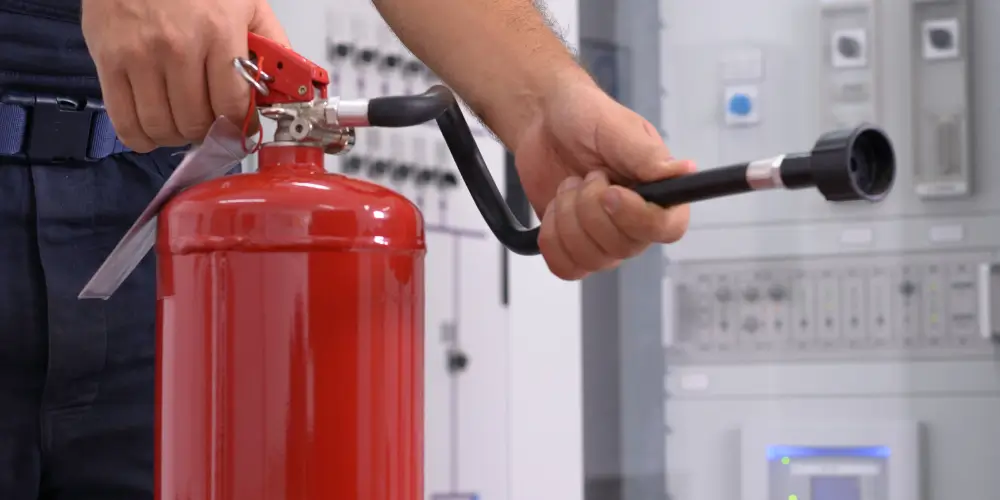
Yes. In a workplace or other non domestic premises, the fire alarm should be raised as soon as a fire is discovered.
Raising the alarm alerts other occupants and allows evacuation procedures to begin. It also ensures that people do not remain unaware of a developing fire while someone attempts to extinguish it.
A person should not spend valuable time trying to extinguish a fire before warning others.
The government guidance for small non domestic premises states that employees should understand when they should not attempt to tackle a fire and that, if in doubt, they should raise the alarm, leave the premises and call the fire and rescue service.
Should You Use a Fire Extinguisher Before Calling 999?
You should not delay calling 999 because you are attempting to use an extinguisher.
If there is a fire that requires the fire and rescue service, the emergency call should be made promptly.
In a workplace, the emergency procedure should establish who raises the alarm, who contacts the fire and rescue service and how evacuation is managed.
If a person is already in a situation where the fire is small and an extinguisher can safely be used, this does not remove the need to summon professional assistance where appropriate.
For domestic fires, UK government advice is particularly clear: do not tackle fires yourself. Get everyone out, stay out and call 999 once you are clear of the building.
What Size Fire Can You Safely Tackle With an Extinguisher?
There is no single measurement in metres or centimetres that defines a fire as safe to tackle with a portable extinguisher.
The important issue is whether the fire is still small and controllable and whether attempting to extinguish it creates an unacceptable risk.
A small fire contained in a waste bin may potentially be manageable. A fire that has already spread across a room, reached the ceiling or begun involving multiple items is much more dangerous.
Heat and smoke are also important indicators. A fire may appear relatively small while generating dangerous smoke or intense radiant heat.
If the fire is developing faster than you can control it, leave immediately.
What Conditions Must Be Met Before Using a Fire Extinguisher?
Several conditions should be satisfied before an extinguisher is considered.
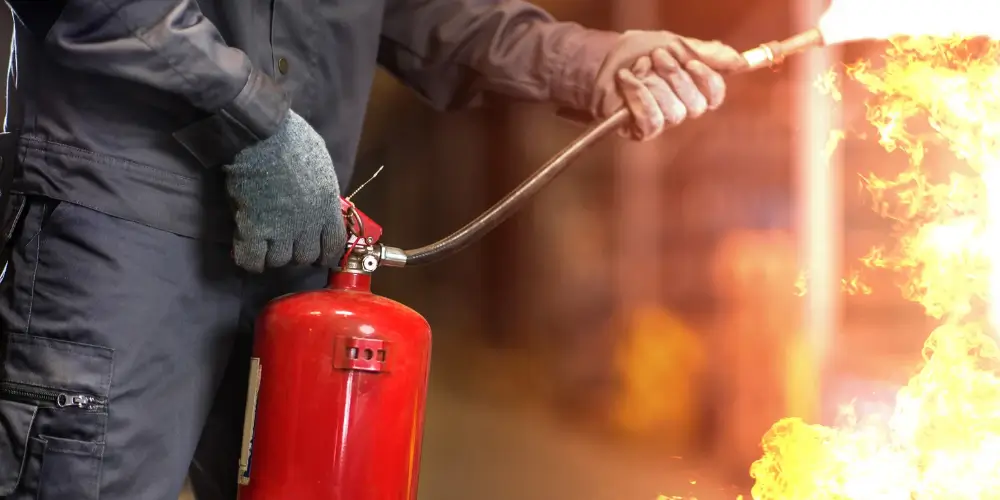
First, the fire should be small and in its early stages. Second, the correct extinguisher must be available. Third, the person using it should know how to operate it safely or have received appropriate training. Fourth, there must be a clear escape route behind the person.
The person should also be confident that they can abandon the attempt immediately if the fire grows or conditions deteriorate.
Government guidance states that extinguishing equipment should be easily accessible and simple to use, while staff should understand the circumstances in which they should not attempt to tackle a fire.
If any of these conditions cannot be met, evacuation is normally the safer option.
Why Must You Keep an Escape Route Behind You?
A clear escape route is one of the most important safety requirements when using an extinguisher.
A person tackling a fire should never position themselves so that the fire is between them and the exit.
If the extinguisher does not immediately control the fire, the person must be able to turn away and leave without having to pass through flames or thick smoke.
UK fire safety guidance emphasises that escape routes should allow people confronted by a fire to turn away from it and escape towards a place of safety.
This principle applies even when a fire initially appears manageable.
Should Untrained People Use Fire Extinguishers?
Untrained people should not be expected to fight fires.
In workplaces, employees should receive suitable fire safety information and training so they understand the emergency procedures and know when it is appropriate to use firefighting equipment.
This does not mean every employee must become a firefighter. The purpose of training is to ensure people understand the limitations of portable extinguishers and recognise when evacuation is the correct action.
If a person has no training and is uncertain about how an extinguisher operates, attempting to fight the fire can increase rather than reduce the risk.
When Should You Not Use a Fire Extinguisher?
You should not use a fire extinguisher when the fire is large, rapidly spreading or producing substantial smoke.
You should also avoid attempting to tackle a fire if you do not have a safe escape route, if you do not have the correct extinguisher or if you are not confident that the extinguisher is suitable.
Do not attempt to fight a fire if flames are blocking your exit.
You should also leave rather than attempting to tackle a fire if conditions are deteriorating or if the extinguisher fails to control the fire quickly.
Government guidance states that if there is doubt, employees should raise the alarm, leave the premises and call the fire and rescue service.
When Should You Use a Water Fire Extinguisher?
A standard water extinguisher is designed primarily for Class A fires involving ordinary combustible materials such as wood, paper, cardboard and textiles.
It should not be used on live electrical equipment or ordinary flammable liquid fires.
Using the wrong extinguishing agent can make a fire more dangerous rather than extinguishing it. UK government guidance specifically states that standard water extinguishers should not be used on liquid, electrical or metal fires.
Some water based extinguishers contain additives and may have additional fire ratings. In such cases, the extinguisher label should be checked to establish exactly what types of fire it has been tested for.
When Should You Use a Foam Fire Extinguisher?
Foam extinguishers can be suitable for Class A and Class B fires.
They are particularly suited to liquid fires involving substances such as petrol and diesel, although their use depends on the particular circumstances and fire risk.
Foam extinguishers should not be used on electrical equipment unless the specific extinguisher has been designed and rated for that purpose.
Government guidance also warns that foam extinguishers should not be used on free flowing liquid fires unless the operator has been specially trained because the fire could spread to adjacent materials.
The label on the extinguisher should always be checked before use.
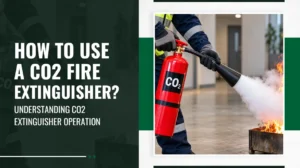
When Should You Use a CO2 Fire Extinguisher?
A carbon dioxide extinguisher, commonly called a CO2 extinguisher, can be suitable for certain electrical and Class B liquid fire risks.
It is commonly found near electrical equipment because it leaves little residue after discharge.
However, CO2 does not provide the same cooling effect as water based extinguishing agents. This means a fire may potentially reignite after the CO2 disperses.
CO2 extinguishers also require careful consideration in confined or poorly ventilated areas because high concentrations of carbon dioxide can present an additional hazard.
The extinguisher should therefore only be used where it is appropriate for the fire and the surrounding environment.
When Should You Use a Dry Powder Fire Extinguisher?
Dry powder extinguishers can be used for several different fire risks and can provide rapid flame knockdown.
They can be suitable for certain Class B fires and electrical equipment.
However, dry powder has significant limitations indoors. It can create a dense cloud that reduces visibility and may affect people with breathing difficulties. It also provides limited cooling, meaning a fire can reignite.
UK government guidance therefore states that powder extinguishers are not generally suitable for enclosed spaces.
A dry powder extinguisher may be more appropriate for certain outdoor or specialist risks than for a confined indoor environment.
When Should You Use a Wet Chemical Fire Extinguisher?
Wet chemical extinguishers are designed particularly for Class F fires involving cooking oils and fats.
They are commonly used in commercial kitchens where deep fat fryers and similar cooking equipment create a specific fire risk.
A cooking oil fire should not be treated like an ordinary petrol or diesel fire.
Government guidance recommends a Class F extinguisher and a fire blanket where cooking involves fat fryers or similar equipment.
The extinguisher should be specifically rated for the cooking fire risk involved.
Can You Use a Fire Extinguisher on an Electrical Fire?
The answer depends on the type of extinguisher.
CO2 extinguishers are commonly suitable for electrical equipment. Dry powder can also be used for certain electrical fires, although it can damage or contaminate equipment and has limitations when used indoors.
A standard water extinguisher should not be used on live electrical equipment.
Foam should also not be used on electrical equipment unless the specific extinguisher is rated and approved for that application.
Government fire safety guidance identifies powder and CO2 as suitable for relevant electrical fire risks, while standard water and ordinary foam extinguishers have restrictions.
Always read the extinguisher’s instructions and fire rating before using it.
Can You Use a Fire Extinguisher on a Gas Fire?
A fire involving a leaking or escaping flammable gas can present a particularly serious risk.
The priority should be to raise the alarm, evacuate and contact the appropriate emergency service. If the gas supply can be safely isolated without approaching the fire or exposing yourself to danger, this should only be done in accordance with the site’s emergency procedures.
Attempting to extinguish a gas flame without stopping the gas supply can create an explosion hazard because unburnt gas may continue to escape and accumulate.
For this reason, a gas fire should not be treated simply as another small fire that can automatically be tackled with a portable extinguisher.
Can You Use an Extinguisher on a Cooking Oil Fire?
You should only use an extinguisher specifically suitable for the cooking oil fire risk.
Commercial cooking oil and fat fires are classified as Class F fires. A suitable wet chemical extinguisher is designed for this type of fire.
Water should never be poured onto burning cooking oil because it can cause the burning oil to erupt and spread.
A fire blanket may also be suitable for some small cooking fires, provided it is used correctly and safely.
If the fire is not immediately controllable, evacuate and call 999.
Can You Use an Extinguisher on an Aerosol Fire?
Aerosol containers can create a particularly dangerous fire scenario because heating can cause the container to rupture.
UK government fire risk assessment guidance specifically states that it is not safe to fight fires involving aerosols with fire extinguishers.
If aerosols are involved in a fire, people should raise the alarm and evacuate rather than attempting to approach the fire with a portable extinguisher.
This is particularly important in workplaces where large numbers of aerosol containers may be stored.
Should You Use an Extinguisher in a Smoke Filled Room?
No.
A smoke filled room can contain toxic gases, reduced oxygen and extremely poor visibility.
Entering or remaining in a smoke filled area to operate a fire extinguisher can expose a person to serious danger.
Smoke can also make it difficult to locate the exit or identify changes in fire conditions.
If smoke is accumulating, the priority should be to leave the area, close doors behind you where appropriate and evacuate the building.
Government fire safety advice for homes specifically states that people should leave rather than tackle fires themselves and should not waste time investigating what has happened.
Should You Use an Extinguisher if the Fire Is Blocking the Exit?
No.
If the fire is between you and your only available escape route, attempting to fight it can trap you.
Even if you have a suitable extinguisher, there is no guarantee that the fire will be controlled.
A fire extinguisher should only be considered when you can maintain a safe escape route throughout the attempt.
If your exit is threatened, leave immediately by another safe route if one is available.
What Should You Do if the Extinguisher Does Not Put the Fire Out?
Stop attempting to fight the fire and evacuate.
Do not remain in the area simply because the extinguisher still contains some extinguishing agent.
A portable extinguisher has limited capacity and is designed for a relatively small fire. If the fire continues to grow after the extinguisher has been discharged, the situation may already be beyond the capability of portable firefighting equipment.
Raise the alarm, leave the premises and call 999.
Do not return to retrieve another extinguisher unless the situation remains clearly safe and this forms part of an appropriate trained response.
Should You Use More Than One Fire Extinguisher?
There is no general rule that a person should use multiple extinguishers against a fire.
If one correctly selected extinguisher does not quickly control a small fire, continuing the attempt can expose the user to increasing danger.
Multiple extinguishers may be required for certain trained workplace response procedures, but this should be covered by the premises fire safety arrangements and staff training.
The priority should always remain safe evacuation.
What Should You Do After Using a Fire Extinguisher?
After an extinguisher has been discharged, the incident should be reported and the premises’ fire safety procedure followed.
The extinguisher should not simply be returned to its normal position and assumed to be ready for another emergency.
A discharged extinguisher may require servicing or replacement, depending on its type and the manufacturer’s instructions.
The incident should also be investigated where appropriate. Even a small fire can reveal problems involving electrical equipment, cooking practices, housekeeping, storage, heating equipment or other fire hazards.
The fire risk assessment may need to be reviewed if the incident identifies a previously unrecognised risk.
How Should Fire Extinguishers Be Positioned?
Fire extinguishers should be located where they can be reached quickly without requiring someone to approach an established fire dangerously.
For general fire risks, government guidance indicates that extinguishers are commonly positioned on escape routes, close to exits from rooms or floors or near the final exit.
Where a particular fire risk is concentrated in one location, such as a flammable liquid hazard, the appropriate extinguisher may be positioned close to that hazard but in a place where it can be safely accessed.
Extinguishers should remain visible and accessible and should not be blocked by furniture, stock or other materials.
How Far Should You Travel to Reach a Fire Extinguisher?
The appropriate travel distance depends on the premises and the level of fire risk.
Government fire safety guidance indicates that, ideally, no one should have to travel more than 30 metres to reach a fire extinguisher in the circumstances covered by its guidance.
This should not be interpreted as an absolute universal rule for every building.
The number and location of extinguishers should be determined through the fire risk assessment and the relevant guidance and standards for the premises.
Who Is Responsible for Providing Fire Extinguishers?
In workplaces and other premises covered by fire safety legislation, the responsible person must ensure that appropriate fire safety measures are provided where necessary.
Government guidance states that the Fire Safety Order requires appropriate firefighting equipment to be provided where necessary and that this will normally include an adequate number of suitable portable fire extinguishers.
The responsible person should ensure that the equipment is appropriate for the risks identified and that it remains accessible, maintained and available for use.
Employees should also receive appropriate fire safety information and training.
Does Every Home Need a Fire Extinguisher?
A domestic home does not automatically require the same portable extinguisher provision as a workplace or commercial premises.
For domestic premises, the emphasis is strongly on preventing fires, installing and maintaining smoke alarms, having a safe escape plan and getting everyone out if a fire occurs.
The UK government’s home fire safety guidance advises people not to tackle fires themselves and instead to get everyone out, stay out and call 999 once clear of the building.
If a household chooses to keep an extinguisher, it should be suitable for the risks present and occupants should understand its limitations.
Having an extinguisher should never encourage someone to remain inside a burning home.
What Is the Difference Between Using an Extinguisher at Home and at Work?
The approach can differ significantly.
In a workplace, the fire risk assessment may identify trained staff or fire wardens who can use portable extinguishers during the early stages of a fire, provided this can be done safely.
In a domestic property, government advice is more direct: people should not tackle fires themselves and should prioritise evacuation.
This difference is important because commercial premises may have formal fire procedures, trained personnel, fire alarm systems, emergency lighting and documented evacuation arrangements.
A homeowner should not assume that the procedures used by trained workplace staff are appropriate for a domestic emergency.
Why Is Fire Training Important Before Using an Extinguisher?
Fire extinguisher training helps people understand both the capabilities and limitations of firefighting equipment.
A trained person is more likely to recognise the correct extinguisher, identify when a fire is too dangerous to tackle and understand the importance of maintaining a clear escape route.
Training should also explain the premises’ fire alarm procedure, evacuation arrangements, assembly point and emergency responsibilities.
The objective is not to encourage people to fight fires. It is to ensure that people understand when firefighting equipment may be used and, equally importantly, when it should not be used.
What Should a Fire Risk Assessment Consider?
The fire risk assessment should identify the fire hazards within the premises and determine whether portable extinguishers are necessary.
It should consider combustible materials, electrical equipment, cooking facilities, flammable liquids, gases, machinery, storage arrangements and other ignition sources.
It should also consider who may be present, whether people may need assistance to evacuate and whether the fire could spread rapidly enough to affect escape routes.
Government guidance states that the number and type of extinguishers should be determined according to the fire risks identified.
The assessment should therefore determine not only whether extinguishers are required but also their type, rating, number and location.
What Are the Most Common Mistakes When Using Fire Extinguishers?
One of the most serious mistakes is attempting to tackle a fire that is already too large.
Another is using the wrong extinguisher. For example, using a standard water extinguisher on a live electrical fire or ordinary flammable liquid fire can create additional danger.
People can also make the mistake of standing too close to the fire, losing their escape route or continuing to fight the fire after the extinguisher has failed to control it.
Another common problem is assuming that an extinguisher is ready for use without checking its condition. Fire extinguishers need appropriate inspection, maintenance and servicing.
Poor positioning can also create problems. An extinguisher hidden behind stock or stored in an inaccessible location may be effectively useless during an emergency.
How Often Should Fire Extinguishers Be Checked?
Fire extinguishers should be subject to appropriate routine checks and professional maintenance.
Government fire safety guidance states that portable fire extinguishing equipment should be subject to periodic inspection, maintenance and testing, with maintenance by a competent person carried out annually under normal conditions.
Routine checks should identify obvious problems such as damage, corrosion, obstruction, missing components or other signs that the extinguisher may not be ready for use.
The exact maintenance arrangements should follow the relevant standard, manufacturer’s instructions and the fire safety arrangements for the premises.
What Should You Do if You Are Unsure Whether to Use an Extinguisher?
If you are unsure, do not use it.
Raise the alarm, evacuate the building and contact the fire and rescue service.
Fire can change rapidly, and a person without suitable training may not be able to judge how quickly conditions are deteriorating.
A fire extinguisher is not worth risking your life for.
The purpose of portable firefighting equipment is to provide a means of first aid firefighting where appropriate. It should never encourage someone to take unnecessary risks.
UK Fire Extinguisher Rules and Fire Safety Legislation
Fire extinguisher provision in workplaces is connected to the wider fire safety duties applying to the premises.
In England and Wales, the Regulatory Reform Fire Safety Order 2005 requires appropriate firefighting equipment to be provided where necessary. Government guidance states that this will normally include an adequate number of suitable portable fire extinguishers.
The exact legal framework differs across the UK. Scotland and Northern Ireland have their own fire safety legislation and guidance, so businesses operating outside England and Wales should check the requirements applicable in their jurisdiction.
Regardless of location, the fundamental safety principle remains the same: people should be able to escape safely, and portable firefighting equipment should only be used where doing so is safe and appropriate.
Frequently Asked Questions
When should you use a fire extinguisher?
A fire extinguisher should only be used on a small fire in its early stages when the correct extinguisher is available, the person is suitably trained or competent and there is a clear escape route behind them.
Should you raise the fire alarm before using an extinguisher?
Yes. The alarm should be raised immediately so that other people are warned and evacuation can begin. Do not delay the alarm while attempting to extinguish the fire.
Should you call 999 before using a fire extinguisher?
You should not delay calling 999 when the fire requires the fire and rescue service. Your premises’ emergency procedure should determine who raises the alarm and contacts the fire and rescue service.
Should an untrained person use a fire extinguisher?
Untrained people should not be expected to tackle fires. If you do not know how to use the extinguisher safely, evacuate and call the fire and rescue service.
How big a fire can you put out with an extinguisher?
There is no universal size limit. An extinguisher is intended for small fires in their early stages. If the fire is spreading, producing heavy smoke or threatening your escape route, you should evacuate.
Should you use a fire extinguisher in a smoke filled room?
No. Smoke can contain toxic gases and can severely reduce visibility. Leave the area rather than entering or remaining in a smoke filled room to use an extinguisher.
What fire extinguisher should you use on paper and wood?
A suitable water extinguisher is normally used for Class A fires involving materials such as paper, wood, cardboard and textiles.
What fire extinguisher should you use on petrol?
Petrol is a Class B liquid fire risk. A suitable foam extinguisher can be particularly appropriate, while other extinguishing agents may be suitable depending on the circumstances and equipment rating.
Conclusion
Knowing when should you use a fire extinguisher UK is ultimately about understanding the limits of portable firefighting equipment.
A fire extinguisher should only be considered when the fire is small and in its early stages, the correct extinguisher is available, the person is suitably trained or competent, the alarm has been raised and there is a clear escape route behind them.
You should never allow the fire to come between you and your exit. You should also avoid attempting to tackle fires involving heavy smoke, rapidly spreading flames, significant quantities of flammable materials or other conditions that could place you in immediate danger.
Choosing the correct extinguisher is equally important. Water is primarily intended for Class A fires, foam can be suitable for Class A and Class B risks, CO2 can be suitable for certain electrical and Class B fires, powder has a broad range of applications but significant indoor limitations, and wet chemical extinguishers are specifically designed for Class F cooking oil and fat fires.
For domestic properties, the UK government’s advice is particularly cautious: people should not tackle fires themselves and should instead get everyone out, stay out and call 999.
In workplaces, suitable fire extinguishers can form part of the fire safety arrangements, and trained staff may potentially use them during the early stages of a fire when it is safe to do so.
The most important rule is simple: if there is any doubt about whether you can safely control the fire, do not attempt to fight it. Raise the alarm, evacuate and call 999.