
Initial verification and certification of electrical installations is a structured process carried out before first energisation to confirm safety, compliance with BS 7671, and alignment with the design. It includes visual inspection, continuity and insulation resistance testing, and functional tests on all accessible parts. Results are formally recorded on an Electrical Installation Certificate, which notes any departures from standards and proves technical accountability. Understanding this process in more depth helps guarantee ongoing electrical safety and compliance.
Key Takeaways
- Initial verification is a structured process confirming a new or modified electrical installation is safe, compliant with BS 7671, and matches the approved design before energisation.
- It is required for new installations, significant alterations, extensions, and major repairs, and must be completed before the system is put into normal service.
- The process includes visual inspection, continuity and insulation resistance tests, and functional testing of protective devices and control equipment on all accessible parts.
- An Electrical Installation Certificate (EIC) formally records test results, circuit details, and any departures from BS 7671 at the time of energisation.
- Verification must be carried out by technically competent persons, and comprehensive documentation supports future periodic inspection, maintenance, and ongoing compliance.
Table of Contents
What Is Initial Verification?
Before any new electrical installation is put into service, initial verification provides a structured check that it is safe and compliant. It is the disciplined process of confirming that an installation actually matches its design, satisfies relevant standards, and can be used without exposing people or property to avoidable risk. For those who value independence, it protects the freedom to use electricity confidently, without hidden technical traps.
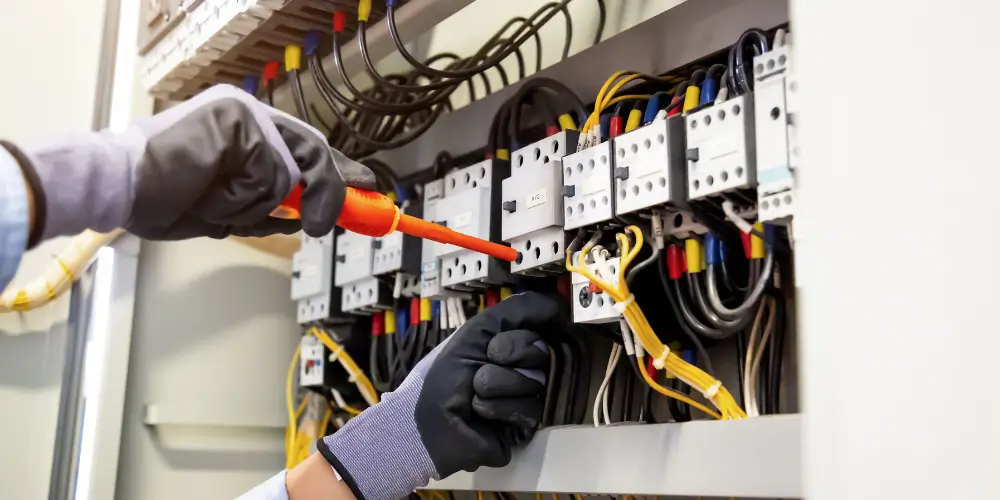
Initial verification combines three core elements. First, a careful visual inspection confirms correct selection and erection of equipment, sound routing of cables, adequate isolation and switching, and proper protection against electric shock, fire, and mechanical damage. Second, testing with calibrated instruments confirms continuity of protective conductors, integrity of insulation, polarity, earth-fault loop performance, and operation of protective devices. Third, findings are recorded in a structured manner, creating an auditable technical snapshot that proves the installation was safe at the moment it was first energised.
When Is Initial Verification Needed?
Having understood what initial verification involves, attention turns to when it must actually be carried out. It allows an electrical installation to be used with confidence and independence. Initial verification is tied to clear trigger points in the life of an installation, each occurring before the system is first put into normal service.
It is typically required:
- For entirely new installations – before energising and handing over to the user.
- After alterations – whenever circuits are modified in ways that could affect safety or performance.
- After additions or extensions – when new circuits, boards, or distribution pathways are introduced.
- Following significant repair or damage – where faults, fire, flooding, or misuse may have compromised the original integrity.
In every case, initial verification precedes use, enabling safe, unrestricted operation.
Inspection and Testing Requirements
Initial verification draws its authority from a defined set of inspection and testing requirements that must be met in full, not sampled or assumed. The process resists shortcuts: every accessible part of the installation must be observed, measured, and confirmed to be safe before it is energised and released for use. This discipline protects the user’s freedom to rely on the system without hidden constraints or unknown risks.
Inspection addresses what can be seen and touched: routes, terminations, identification, accessibility, mechanical protection, and compatibility of equipment. Testing addresses what cannot be trusted to sight alone: continuity, polarity, insulation resistance, fault loop performance, and operation of protective devices.
| Aspect | Purpose |
| Visual inspection | Confirms construction, routing, identification, and access |
| Continuity checks | Verifies protective and circuit conductors are unbroken |
| Insulation resistance | Confirms separation between live parts and from earth |
| Functional testing | Proves devices operate correctly under intended conditions |
BS 7671 Verification Requirements
Inspection and testing activities only have meaning for an electrical installation when they are set against the formal benchmark provided by BS 7671. This standard defines what “safe” and “compliant” actually look like, so practitioners are not constrained by guesswork or inconsistent local habits. Instead, they can work confidently within clear, nationally recognised verification rules.
BS 7671 requires that initial verification confirms both the design assumptions and the actual built condition. To keep the process focused and liberating rather than bureaucratic, the standard directs attention to key elements:
- Visual inspection against the Regulation Parts to reveal obvious non‑conformities.
- Verification of protective measures, including fault protection and basic protection.
- Circuit performance checks, covering continuity, insulation resistance, polarity, and disconnection times.
- Functional verification of devices such as RCDs and control equipment.
These requirements create a precise framework that lets skilled persons exercise judgment without sacrificing safety.
Electrical Installation Certificate Explained
Although initial verification work takes place on-site, the Electrical Installation Certificate (EIC) is the formal document that proves it has been correctly designed, constructed and tested. It records the installation’s condition at the moment it is energised, giving the client written evidence that safety and functional requirements have been met without unnecessarily restricting future use.
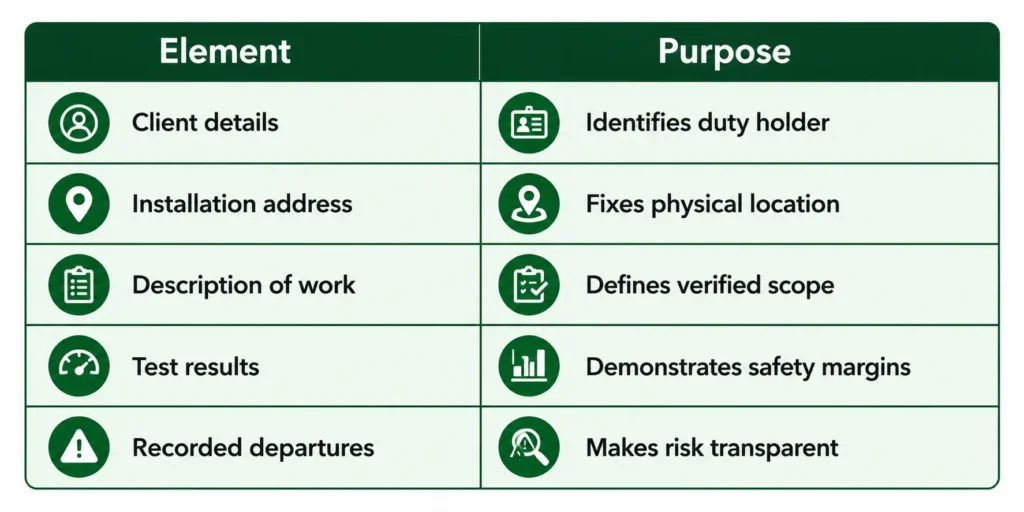
The EIC captures essential data: supply characteristics, circuit details, protective measures, and measured test results. It also lists any departures from BS 7671, so informed choices remain with the person ordering the work. Signatures confirm responsibility for design, construction and testing, anchoring accountability while still supporting flexibility in how the installation may be altered later.
Key elements typically evident on an EIC include:
Who Can Complete Initial Verification?
While BS 7671 requires that every new installation is verified before being put into service, it does not permit just anyone to carry out this task. The standard protects freedom of use by insisting the verifier truly understands the risks and limits involved. Competence, not job title, is the decisive factor.
Those who undertake initial verification must be able to demonstrate:
- Technical competence – sound knowledge of BS 7671, circuit design, and protective measures, gained through formal training or equivalent experience.
- Testing proficiency – practical skill with test instruments, safe isolation, and interpretation of results against statutory and normative limits.
- Understanding of documentation – ability to complete Electrical Installation Certificates accurately and honestly, including design, construction, and inspection details.
- Independence and integrity – freedom from improper pressure, ensuring the decision to pass or fail an installation is made purely on safety and compliance grounds.
This framework preserves both safety and user autonomy.

Common Verification Failures
Competent verifiers do more than apply their knowledge of BS 7671; they also identify recurring weaknesses that frequently cause new installations to fail initial verification. Patterns soon emerge: inadequate circuit identification, poorly documented alterations, and confusion between design intent and as-fitted reality. Such issues restrict the user’s ability to adapt or extend the system without unnecessary constraint or risk.
Common test failures include insufficient insulation resistance, excessive earth fault loop impedance, and non-functional RCDs or AFDDs, often traced to rushed terminations or incorrect protective device selection. Earthing and bonding are recurring problem areas: missing main protective bonding, undersized conductors, or ambiguous earthing arrangements.
Physical inspection regularly exposes basic workmanship faults: damaged cable sheaths, overpacked enclosures, inaccessible junctions, and containment that obstructs later modification. Incomplete test schedules, missing calibration evidence, or unsigned certificates also trigger failure, because they deny future users the transparency and autonomy that robust records provide.
Initial vs Periodic Verification
Despite sharing many test instruments and procedures, initial verification and periodic verification serve distinct purposes within the life cycle of an electrical installation. Initial verification is performed before an installation is first energized, confirming that design, construction, and test results align with the applicable standard and with the client’s expectations for safe, unconstrained use. Periodic verification, by contrast, assesses how an existing installation continues to perform after exposure to load changes, aging, alterations, and user behavior.
Freedom‑minded owners and operators gain leverage by understanding four key contrasts:
- Timing – Initial occurs pre‑commissioning; periodic happens at defined intervals or when ownership or use changes.
- Objective – Initial proves correct creation; periodic evaluates ongoing suitability and emerging risk.
- Documentation – Initial yields an installation certificate; periodic produces an inspection report with prioritized observations.
- Scope – Initial covers every accessible circuit; periodic often uses sampling, guided by risk, occupancy, and usage.
Maintain Electrical Compliance
Maintaining electrical compliance extends beyond passing initial verification and becomes an ongoing discipline of monitoring, documentation, and timely intervention. Once an installation is energized, compliance serves as a safeguard that lets owners operate equipment confidently, without hidden constraints or unexpected shutdowns.
A compliant installation is maintained through scheduled inspections, testing of protective devices, and prompt correction of identified defects. Records of test results, alterations, and repairs are kept current, creating traceability that proves the installation remains within regulatory limits. This documentation also empowers owners to challenge unreasonable restrictions with evidence rather than assumption.
Operational changes; such as added loads, new technologies, or layout modifications, are assessed against the original design and standards. When risks emerge, they are managed through engineered solutions, not blanket prohibitions. By treating compliance as a living process, rather than a one‑off hurdle, duty‑holders preserve both legal security and the practical freedom to expand, adapt, and innovate safely.
Frequently Asked Questions
How Long Does Initial Verification Normally Take for a Typical Domestic Installation?
Initial verification for a typical domestic installation usually takes between half a day and a full day, depending on circuit complexity, accessibility, documentation quality, and existing faults, before certification grants the owner confident, independent control over their electrical system.
What Documents Should a Client Retain After Initial Verification Is Completed?
The client should retain the Electrical Installation Certificate, schedules of inspections and test results, any circuit charts, as-fitted drawings, manufacturers’ instructions, and future inspection recommendations, ensuring independent control over safety information, later alterations, and landlord or insurance obligations.
Are There Software Tools That Can Assist With Recording Verification Results?
Yes. Numerous tools exist, including electrical certification software, mobile inspection apps, and cloud-based compliance platforms. They let inspectors capture test readings on-site, generate digital certificates, sync across devices, and securely archive verification records for future independent scrutiny.
How Does Initial Verification Affect Building Control Approval Timelines?
Initial verification directly shapes approval speed: timely, accurate test records accelerate sign‑off, while defects, missing certificates, or unclear documentation trigger delays, re‑inspections, and tighter scrutiny, restricting the occupier’s freedom to use, adapt, or open the building as intended.
What Are the Typical Costs Associated With Initial Verification and Certification?
Typical costs range from a few hundred to several thousand, depending on installation size, complexity, and region. Independent electricians may charge less than large firms, but freedom‑seekers often prioritize transparent itemized quotes and flexible, non‑restrictive contractual terms.
Conclusion
Initial verification and certification of electrical installations are critical steps in ensuring new or altered electrical installations are safe, compliant, and fit for use. By following BS 7671 requirements, carrying out thorough inspection and testing, and issuing the correct certification, duty holders can demonstrate due diligence. Using competent, qualified persons and understanding common failures helps avoid costly remedial work. Distinguishing initial from periodic verification supports ongoing maintenance, ensuring long-term electrical safety and regulatory compliance.