
An EICR F1 code identifies an immediate danger on an electrical installation that could cause serious injury if not addressed. It signals exposed live conductors, damaged insulation, missing earths, or similar hazardous faults that require urgent isolation and repair. Occupants should avoid affected circuits, isolate them at the consumer unit if safe to do so, and contact a registered electrician. Landlords must restrict access and document actions. Further sections explain typical causes, repair options, costs and follow‑up inspection expectations.
Key Takeaways
- F1 on an EICR means an immediate danger exists that could cause injury, requiring urgent action and isolation of the affected circuit.
- Common causes include exposed live conductors, damaged insulation, missing earths, overheating, or water ingress.
- Do not use the suspect sockets/appliances; isolate the circuit at the consumer unit if it can be done safely.
- Contact a registered electrician immediately for inspection, repair, and verification before restoring the circuit to use.
- Landlords/homeowners must restrict access, document actions, notify occupants, and retain records of repairs and compliance.
Table of Contents
What an EICR F1 Code Means
An EICR F1 code indicates a potentially dangerous condition found during an Electrical Installation Condition Report: a danger of injury. The report assigns F1 when an installation element poses a clear risk to persons but is not imminently life-threatening; it flags issues such as exposed conductors, missing earth connections, or damaged insulation that could cause shock or burns.
Inspectors record location, description, and severity, enabling owners to prioritise corrective action. The designation is distinct from advisory notes or lower-priority findings, signaling immediate attention rather than routine maintenance. Recipients are informed of legal and practical implications: continued use may contravene safety obligations and increase liability.
The summary focuses on factual identification rather than remediation steps, empowering occupants and managers to seek qualified assessment and repair. Clear documentation supports compliance, insurance considerations, and informed decisions about occupation or temporary isolation of affected circuits until competent intervention occurs. If you want to know more about an unsatisfactory report, read our blog post EICR Report Unsatisfactory: What It Means and How to Fix It.
How Dangerous Is an F1 and What to Do Immediately?
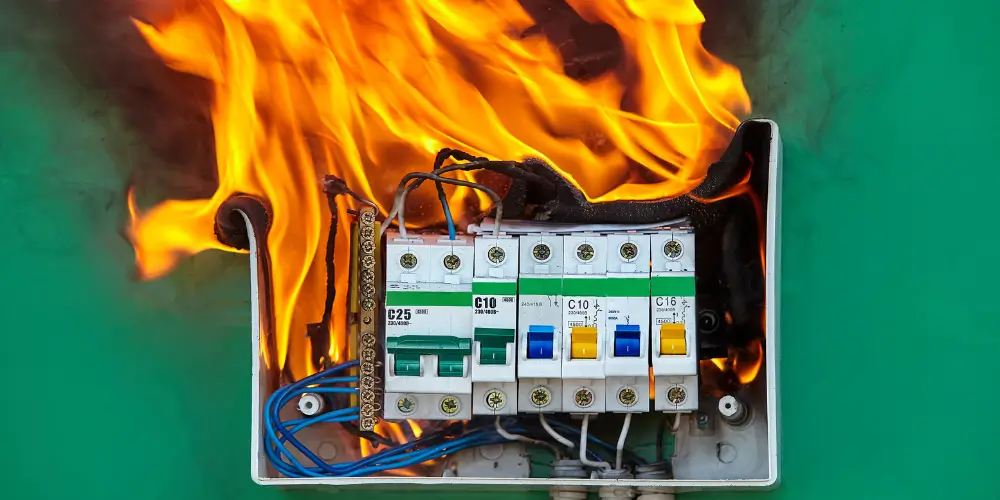
A reported F1 indicates a real risk of injury and should be treated with heightened caution until qualified remedial work is completed. It signifies a potentially dangerous electrical fault that could cause shock, fire, or damage if left unattended.
The immediate priority is to minimise exposure: isolate the affected circuit at the consumer unit or main switch if safe to do so, and avoid using suspect sockets, switches, or appliances. Occupants retain the freedom to act responsibly, turn off and unplug devices and keep clear of damp or metal surfaces that might conduct electricity.
Contact a competent, registered electrician promptly to arrange inspection and repairs; temporary measures should not replace professional remediation. Document the location and nature of the F1 observation for the electrician. If there are signs of burning, smoke, or scorch marks, evacuate the area and call emergency services. Maintaining caution, prompt professional intervention, and clear communication preserves safety and autonomy.
F1 vs C1, C2 and FI: Quick Comparison
Clear distinctions between fault codes help prioritise responses: F1 denotes a dangerous condition requiring immediate remedial action, C1 indicates an urgent safety issue that also needs timely correction, C2 flags a non-urgent defect that should be remedied to prevent future risk, and FI refers to items of further investigation where the inspector could not fully assess a condition. The comparison clarifies severity, required timing, and inspector confidence so decisions can be made freely and confidently.
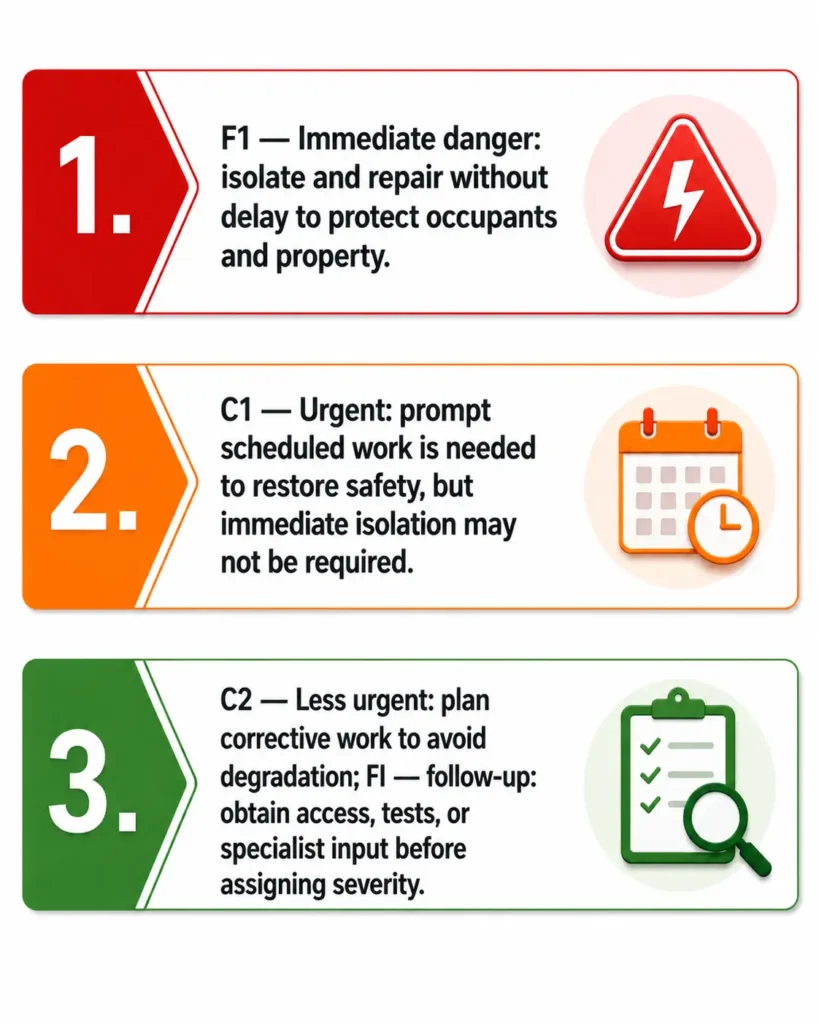
This concise guide equips readers to interpret reports, set priorities, and exercise autonomy when arranging competent remedial action. These codes are also called the fault codes; explore more EICR Fault Codes Explained: Understanding Electrical Safety in UK Properties.
Common Electrical Faults That Trigger an F1
Identify faults that commonly trigger an F1 to prioritise immediate isolation and repair. Typical causes include exposed live conductors, broken or missing protective insulation, and dangerously damaged wiring that creates touch or shock risks. Overloaded circuits with evidence of overheating, burning smells, or charred terminals also qualify when they present a direct threat to users. Faulty earthing or bonding that fails to provide a reliable protective path, as well as damaged consumer units with inaccessible or loose live parts, are frequent F1 findings.
Electrical installations compromised by water ingress wet sockets, damp junction boxes, or corrosion pose immediate danger and often earn an F1. Improvised or makeshift repairs that leave live parts exposed, and damaged equipment with internal faults visible during inspection, similarly trigger urgent action. These faults are documented to prevent use until competent persons isolate and repair them, preserving occupants’ freedom from preventable electrical harm.
Actions Landlords and Homeowners Should Take After an F1
Upon receiving an F1 classification, landlords and homeowners must immediately restrict access to the affected circuits or areas and refrain from using any suspect outlets or fittings until a qualified electrician has isolated and remedied the fault. The property holder should document the report, notify tenants or household members, and prevent unauthorised restoration of supply. Freedom-minded occupants value clear, decisive steps that restore safe autonomy without needless delay.
- Contact a registered electrician promptly, provide the EICR details, and arrange an inspection to confirm the fault location and required isolation.
- Inform tenants in writing, record access restrictions, and, where necessary, provide temporary alternatives that preserve occupants’ mobility and comfort without compromising safety.
- Keep records of communications, actions taken, and any temporary measures; retain the EICR and subsequent certificates to demonstrate compliance and support future freedom of choice in maintenance.
These actions balance safety, legal duty, and respect for occupants’ independence while awaiting professional remediation.
EICR F1 Repair Options and Typical Costs
Evaluating repair options after an F1 classification typically involves choosing among immediate isolation; targeted repair by a qualified electrician; full circuit replacement; or rewiring of affected sections. Costs vary widely based on fault severity, access difficulty, and local labour rates.
A straightforward repair replacing damaged wiring, terminals, or accessories often incurs modest labour and parts costs, and is suitable when the fault is localised and accessible. More extensive work, such as replacing an ageing circuit or rewiring a room, increases material and time costs and may require access panels or decorative repairs. Emergency call-outs and urgent isolation increase costs, while planned work can be scheduled to reduce disruption and costs.
Landlords and homeowners who prefer autonomy should obtain multiple quotes, request detailed scopes of work, and confirm electricians’ credentials and insurance. Clear estimates help compare value rather than price alone. Budgeting for a 10–25% contingency is prudent, reflecting unforeseen complications that may arise when walls or ceilings are opened.

What to Expect From a Follow-Up Inspection or Re-Test
A follow-up inspection or re-test verifies that the defects noted in the original EICR, such as an F1 fault,t have been correctly isolated, repaired, or replaced and that the affected circuit(s) now meet the required safety standards; the inspector confirms compliance and documents outcomes. The process is straightforward, transparent, and aimed at restoring the installation’s safe, unrestricted use.
- The inspector rechecks repaired items, repeats relevant tests (continuity, insulation resistance, earth loop impedance), and inspects workmanship to guarantee no shortcuts compromise safety.
- Test results are compared with previous findings; passing values are recorded,d and any outstanding issues prompt further action or scheduling of additional work.
- A clear re-test report is issued, indicating whether the F1 condition is resolved, summarising tests performed, and advising on next steps or certification, enabling the owner to proceed with confidence and autonomy.
Preventing Future EICR F1 Faults: Maintenance Checklist
Implementing routine maintenance greatly reduces the risk of recurring F1 faults on an EICR by ensuring protective devices, wiring, and earthing remain in safe, serviceable condition. A clear maintenance checklist preserves operational freedom and minimises constraint from unexpected failures.
Items should include periodic inspection of protective devices (MCBs, RCDs) with functional testing and replacement where tripping characteristics degrade; tightening and cleaning of consumer unit connections; thermal scanning of distribution boards to detect hotspots; continuity and insulation testing of bonding and earthing conductors; verifying circuit labelling and load distribution to avoid overloads; checking cable routes for mechanical damage and signs of deterioration; confirming integrity of flexible leads and portable appliance connections; documenting all interventions and scheduling next checks based on environment and usage.
Where defects are found, prioritised corrective action prevents recurrence. Adopting this disciplined, minimal-burden program enables occupants to maintain electrical independence and reduces reliance on emergency interventions.
Frequently Asked Questions
Does an F1 Affect Home Insurance Coverage?
Yes. An F1 can influence home insurance: insurers may require repairs before cover continues, increase premiums, or decline renewal. The policyholder should proactively disclose, negotiate terms, and arrange certified remedial work to preserve freedom of coverage choices.
Can an F1 Be Ignored for Cosmetic-Only Fixtures?
No it cannot be ignored. They state that an F1 indicates immediate risk; even cosmetic fixtures presenting faults must be addressed or isolated. Freedom-seeking owners should promptly rectify or legally document isolation to avoid liability.
Will an F1 Appear on Property Sale Documents?
Yes. They note that an F1 may appear on property sale documents if the seller discloses the EICR or if a buyer requests reports; the notation can affect negotiations, though recording practices vary by jurisdiction and preference.
Are Landlords Legally Required to Fix All F1S Immediately?
No; landlords aren’t universally bound to fix every F1 immediately. They must address dangerous faults promptly under safety regulations and tenancy laws, but timing and obligations depend on local statutes, contracts, and risk assessments.
Can Tenant-Reported Issues Cause False F1 Markings?
Yes. They note that tenant-reported issues can lead to mistaken F1 markings when misleading symptoms, incomplete inspections, or communication errors occur; an independent re-inspection or clarification often resolves such disputes without immediate enforcement.
Conclusion
An EICR F1 designation indicates a potentially dangerous fault that requires prompt attention. Prompt action to isolate affected circuits and arrange repairs by a qualified electrician reduces the immediate risk. Unlike C1/C2 classifications, F1 highlights a specific fault rather than the overall condition, but it still warrants timely correction and re-testing to ensure safety. Landlords and homeowners should document repairs, understand likely costs, and adopt routine maintenance to prevent recurrence, with a follow-up inspection to confirm the issue has been properly resolved.