
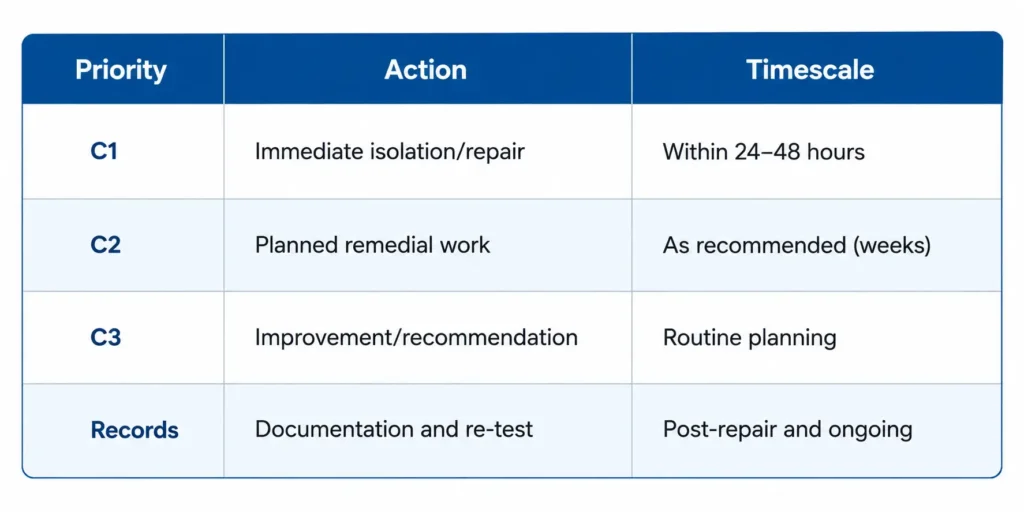
EICR codes classify electrical defects by risk. C1 denotes immediate danger requiring urgent isolation and a qualified electrician within 24–48 hours. C2 signals a potentially dangerous condition needing prompt planned repairs or temporary measures to reduce risk. C3 covers non‑dangerous observations suited to routine maintenance or upgrades. Findings guide prioritisation, record-keeping, and communication with tenants or stakeholders. Further sections explain priorities, timelines, costs and what to expect from electricians.
Key Takeaways
- C1 means immediate danger present; isolate circuits and call a qualified electrician for urgent repair within 24–48 hours.
- C2 indicates a potentially dangerous condition requiring prompt remedial work and prioritised scheduling.
- C3 denotes non-dangerous observations needing monitoring or inclusion in planned maintenance.
- Codes guide risk-based prioritisation, temporary measures, and clear communication with electricians and occupants.
- Keep EICR records and evidence of repairs to demonstrate compliance and schedule re-inspection if advised.
Table of Contents
Quick Answer: What C1, C2 and C3 Mean for You
Classifications C1, C2 and C3 on an Electrical Installation Condition Report (EICR) indicate increasing levels of concern about an installation’s safety: the inspector assigns them to convey urgency and required action. C1 denotes an immediate danger needing prompt remedial work or disconnection to eliminate a risk of electric shock or fire. C2 identifies potentially dangerous conditions that are not immediately life-threatening but require corrective work within a defined timescale to prevent escalation.
C3 covers observations that do not pose an immediate danger but represent deterioration, non-compliance, or items that could become unsafe in the future; these typically call for monitoring or planned upgrades. Together these codes help property owners, managers and technicians prioritise responses, allocate resources and schedule repairs. The classifications are intended as practical guidance: they do not prescribe exact remedial methods but rather communicate severity so that competent persons can decide on appropriate interventions and timelines.
EICR Codes Explained: C1, C2, C3 and FI
An Electrical Installation Condition Report (EICR) uses four key outcome codes, C1, C2, C3, and FI, to communicate the severity and required action for observed electrical defects. C1 (Danger Present) denotes defects presenting an immediate risk of injury or fire; urgent remedial action is required. C2 (Potentially Dangerous) identifies conditions that could become hazardous and need timely attention, often before the next inspection cycle. C3 (Improvement Recommended) flags non-compliant or substandard installations that do not pose immediate danger but should be corrected to meet best practice and improve safety.
FI (Further Investigation) indicates that the inspector could not fully determine the condition during the assessment and recommends additional investigation, testing, or access to concealed areas to establish whether a C1, C2, or C3 applies. Together these codes provide a clear, prioritised framework enabling owners, landlords and managers to plan repairs, manage risk and comply with safety obligations.
Is C1 an Emergency? What to Do Now
When a C1 code appears on an EICR, it signifies an immediate danger that requires prompt action to eliminate risk to people and property. The report indicates a fault or condition presenting a high risk of injury, fire, or further deterioration. Occupants and managers should treat it as an emergency until a qualified electrician confirms otherwise. Immediate steps focus on isolating risk and securing safety while avoiding unnecessary interference with electrical systems.
- Disconnect or isolate the affected circuit if safe to do so, and clearly label the isolation.
- Evacuate or restrict access to areas where the hazard is present to protect people from shock or fire.
- Contact a competent, registered electrician immediately and provide the EICR details and location of the fault.
- Keep a record of actions taken and any temporary measures until a professional completes a permanent repair.
When C2 Needs Prompt Repairs: How to Prioritise
Although less urgent than a C1, a C2 fault on an EICR still represents a potentially dangerous situation that requires timely attention to prevent escalation. Decisions about prioritising repairs hinge on risk factors: the location of the fault (e.g., communal areas, damp rooms), the likelihood of contact, and potential consequences such as fire or electric shock. A practical approach ranks items by immediacy; address defects that affect protective devices, exposed live conductors, or circuits supplying high-risk areas first.
Next come faults increasing deterioration or moisture ingress risks. The availability of temporary measures, such as isolating a circuit or posting warning notices, can provide short-term mitigation while arranging qualified repairs. Costs and disruption are secondary to safety, so scheduling must balance urgency with operational constraints; critical fixes should not be postponed for convenience. Clear communication between the responsible person and the electrician ensures agreed-upon timelines, documented actions, and ongoing monitoring until the C2 condition is rectified. Check out the detailed guidance for code C2: How Do You Know EICR C2 Meaning? A Clear Guide to Electrical Safety Risks
C3 Findings: Minor Defects and Planned Maintenance
C3 findings denote minor defects that do not present an immediate danger but warrant attention within a planned maintenance cycle. They typically indicate issues such as wear, degradation, or suboptimal installation that should be scheduled for correction to prevent escalation. The report flags these items so that building managers and owners can plan resources, budgets, and timing without urgent disruption.
- Documented examples: loose connections, minor insulation damage, or non-critical labeling errors that are serviceable on a routine visit.
- Risk framing: low immediate risk but potential to worsen if ignored, making them suitable for inclusion in maintenance plans rather than emergency repairs.
- Planning implications: scheduling, prioritisation, and budgeting are guided by C3 entries to maintain compliance and asset longevity.
- Record-keeping: keeping clear records of C3 items, planned actions, and review dates aids follow-up and demonstrates a proactive approach to electrical safety.
How Electricians Assess, Fix and Sign Off EICR Issues
Inspecting an EICR begins with a systematic assessment in which the electrician verifies reported defects, performs targeted tests, and evaluates the circuit’s overall integrity against regulatory criteria. Next, findings are classified as C1, C2, or C3, and each item’s severity determines the remedial priority. For urgent C1 and significant C2 faults, the electrician isolates circuits, implements immediate safety measures such as replacing damaged protective devices, repairing earthing/bonding faults, or correcting wiring faults, and retests to confirm compliance.
For C3 or advisory items, recommendations are recorded for planned attention. Repairs follow manufacturer guidance and wiring regulations; parts and methods are selected to restore protective functions without introducing new risks.
After corrective work, the electrician repeats the relevant insulation, continuity, and polarity tests and documents the measured values. A clear report, including descriptions of actions taken, test readings and any outstanding items, is provided. Where full compliance is achieved, the electrician signs off the EICR, certifying the installation meets current safety standards.

EICR Timeline, Typical Costs and Paperwork
A typical EICR process follows a predictable timeline, with initial scheduling and on-site inspection usually completed within one working day for a standard domestic property; larger or more complex premises can require multiple days. The report is compiled after testing and is often issued electronically within 24–72 hours. For detailed information about the factors that effect the inspection period, read our blog post How Long Does an EICR Take? A Complete Guide to Electrical Safety Inspections
Costs vary by size and complexity: a simple flat has a lower fixed fee, while houses, HMOs, or commercial sites incur higher charges and may require hourly rates for remedial work. Paperwork includes the formal EICR document, recommendations for any C1/C2 actions, timescales for remedial work, and a record of test results and signatures.
- Typical timeline: scheduling, inspection, report drafting, delivery.
- Typical costs: base inspection fee, extras for circuits, travel, remedials.
- Paperwork elements: certificate, schedules of defects, test readings.
- Record keeping: retain the EICR and evidence of any subsequent repairs for compliance and future reference.
Practical Checklist: Next Steps After Your EICR
Begin by reviewing the EICR summary and the schedule of defects to identify any C1 or C2 issues and their recommended timescales; this establishes priorities for immediate action, planned repairs, and compliance documentation. The person responsible should log urgent actions, arrange for a qualified electrician to attend, and confirm isolation procedures. For C3 observations, plan improvements and monitor non-urgent items. Maintain clear records: dates, contractor details, works completed and test certificate updates. Communicate findings to tenants or stakeholders and align with regulatory or lease requirements. Schedule re-inspection where advised and update asset registers. Here you can find the EICR Test Checklist: The Complete Landlord Guide No 1 to Electrical Safety
Frequently Asked Questions
Can Tenants Request a Copy of the EICR From Their Landlord?
Yes. A tenant can request a copy of the EICR from their landlord; the landlord should provide it when available. If withheld, the tenant may seek advice from local housing authorities or legal services to enforce compliance. Know about the EICR report: What Does an EICR Report Look Like?
Can EICR Codes Affect Home Insurance Premiums?
Yes. Insurers may raise premiums or decline cover if EICR codes indicate significant electrical risk; unresolved C1/C2 defects or unsafe installations can increase perceived liability, while a satisfactory EICR can help maintain standard premiums.
How Long Do Electricians Keep Records of Past EICRS?
Electricians typically retain past EICR records for about six years, aligning with warranty, insurance, and regulatory reference needs; some firms keep them longer for business continuity, client service, or legal protection.
Are Portable Appliance Tests (PAT) Included in an EICR?
No; an EICR typically does not include PAT testing. It records fixed electrical installation condition, while PAT covers portable appliance safety checks. Clients usually arrange PAT separately, though reports may be cross-referenced for completeness.
Can DIY Electrical Work Influence EICR Outcomes?
Yes. DIY electrical work can affect EICR outcomes: poorly executed or non-compliant repairs often result in recorded defects, recommendations, or failure notes, whereas correct, certified work tends to yield cleaner inspection results.
Conclusion
When an EICR flags C1, C2, C3 or FI, understanding their urgency helps prioritise action: C1 demands immediate disconnection or isolation; C2 requires prompt repair or replacement; C3 points to non-urgent improvements, while FI indicates further investigation. Electricians assess risks, carry out remedial work and sign off once safe. Tenants and owners should follow guidance, schedule necessary repairs, retain paperwork, and plan a reinspection to ensure ongoing electrical safety and regulatory compliance.