The answer to the most asked question, “Who is responsible for enforcing fire safety,” is that it is a shared responsibility between internal dutyholders and external regulators. Day-to-day enforcement usually sits with the employer, building owner, or appointed ‘responsible person’ who controls budgets, rules, and maintenance. This person must keep a current fire risk assessment, maintain alarms and escape routes, and provide training and drills. Local fire authorities audit compliance and can issue enforcement or prohibition notices. The sections below explain how these roles work together.”
Key Takeaways
- Government fire authorities enforce baseline workplace fire safety laws through inspections, audits, and formal notices.
- Occupational safety agencies investigate serious hazards and can require corrective actions or restrict unsafe operations.
- The employer or building owner, as the “responsible person,” must assess risks and implement fire precautions day to day.
- Site management enforces internal policies by maintaining equipment, keeping escape routes clear, and delivering training and evacuation drills.
- Insurers also drive compliance by requiring documented fire controls and maintenance as conditions of coverage.
Table of Contents
Who Enforces Workplace Fire Safety (Quick Answer)?
In most workplaces, fire safety is enforced by a combination of public regulators and internal management. Government fire authorities or building inspectors set baseline rules, verify compliance through audits, and can issue notices, fines, or closure orders when serious risks persist. In some jurisdictions, occupational safety agencies also investigate hazards and require corrective action.
Inside the workplace, management typically implements these legal minimums through policies, maintenance schedules, training, and routine checks. Landlords, property managers, and contractors may also be involved where they control alarms, sprinklers, exits, or building alterations.
Insurers can add pressure by requiring documented controls as a condition of coverage. Employees contribute by following procedures, keeping escape routes clear, and reporting defects, while retaining the right to speak up without retaliation. In practice, enforcement is shared: the state sets the floor, and the workplace maintains it day-to-day.
Who Is the “Responsible Person” in a Workplace?
Although regulators set the baseline, day-to-day accountability for workplace fire precautions usually sits with the “responsible person” under fire safety legislation, the individual legally tasked with ensuring that fire risks are assessed, controls are put in place, and evacuation measures remain effective.
“In practice, who is responsible for enforcing fire safety is usually the employer, building owner, occupier, or a senior manager with real authority over premises and people. The title is not honorary; it follows control. Whoever can set budgets, approve changes, manage contractors, and establish site rules is typically expected to carry out the role.”
In multi-occupied buildings, more than one responsible person may exist, each covering their own area and sharing responsibilities for common parts. Where management is outsourced, a facilities company may be involved, but accountability generally remains with those who control the business and premises. Clear appointment and reporting lines protect autonomy by preventing confusion when it matters most.
What the Responsible Person Must Do (Legal Duties)
Legal duties form the core of the responsible person’s role: they must carry out and keep up to date a suitable and sufficient fire risk assessment, implement proportionate preventive and protective measures, and ensure that safe means of escape, effective warning systems, and appropriate firefighting equipment are in place and maintained.
They must identify who is at risk, including people with disabilities, lone workers, and visitors, and remove or reduce hazards at source wherever reasonably practicable. Clear routes and exits must be kept unobstructed, with suitable signage and emergency lighting where needed.
Who is responsible for enforcing fire safety includes ensuring fire doors, compartmentation, and any controls that limit smoke spread are preserved, not wedged open or compromised by alterations. Dutyholders must record significant findings, plan for emergencies, and share relevant information with other occupiers in shared premises.”
In multi-tenant buildings, they must coordinate to avoid gaps, duplication, and needless restrictions on lawful work.
Employer Workplace Fire Safety Duties (Training, Drills, Equipment)
Employers must turn fire safety arrangements into day‑to‑day practice by providing suitable training, running realistic evacuation drills, and ensuring fire safety equipment is correctly selected, available, and maintained.
Training should be role‑relevant, brief, and repeatable, covering alarm signals, evacuation routes, shutdown actions where needed, and how to raise concerns without delay. Induction and refresher sessions help keep knowledge current as layouts, processes, or occupancy change. Drills should be scheduled often enough to prove that exits, signage, lighting, and assembly arrangements work under real pressure, with timed results and recorded learning points.
Equipment duties include selecting the right alarms, detectors, emergency lighting, extinguishers, fire doors, and signage for the specific risks, and keeping them accessible and in good working order. Regular inspections, servicing by competent providers, clear records, and prompt fixes protect continuity and prevent small faults from becoming enforced shutdowns.
Employee Fire Safety Responsibilities at Work
Every workplace fire plan relies on employees consistently doing the basics: following site rules, keeping escape routes and fire doors clear, and responding immediately to alarms by evacuating via the designated routes to the assembly point. Personal responsibility protects individual freedom by preventing one person’s choices from endangering others or disrupting work.
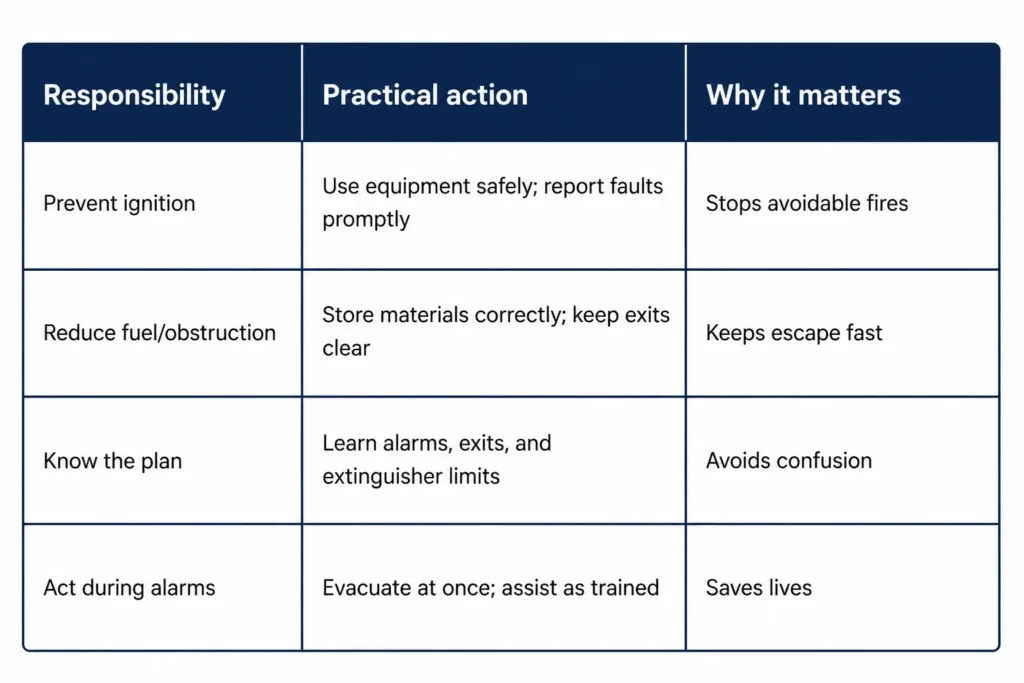
Employees should avoid disabling detectors, wedging fire doors open, or ignoring “no smoking” and hot-work controls. They should raise concerns early, but never improvise heroics beyond training; choosing safe evacuation preserves life and keeps emergency services unimpeded.
Managers’ Day-to-Day Fire Safety Checks and Supervision
Consistent employee behaviour works best when managers reinforce it through visible, routine supervision and quick corrections. Day-to-day enforcement is less about heavy-handed control and more about removing friction that leads to unsafe shortcuts.
Managers typically set the tone by keeping exits and routes clear, ensuring fire doors close properly, and challenging any practice that blocks alarms, extinguishers, or panels. Practical checks include brief walk-throughs, verifying that escape signage is lit, confirming alarms show normal status, and noting housekeeping risks such as overloaded sockets or stored combustibles near heat sources.
Managers also supervise higher-risk activities by confirming permits, separating ignition sources, and ensuring competent people are present. When issues appear, they record them, assign fixes, set deadlines, and follow up. Supervision stays compatible with autonomy by explaining “why,” offering simple options, and correcting privately. Consistency makes compliance predictable, not oppressive. Explore more about Understanding Fire Safety in the Workplace: Legal Requirements and Best Practices.

Landlords, Owners, Tenants, and Contractors: Who Does What?
Although fire risk often feels like an “in-house” issue, responsibility can be shared across landlords, building owners, tenants, and contractors, with duties shaped by who controls the premises, who creates the risk, and what the lease or contract assigns.
Landlords and owners typically carry responsibility for the structure: protected escape routes, fire doors, alarm and detection infrastructure, emergency lighting, and maintenance of common areas. Tenants usually control day-to-day occupation and must manage housekeeping, storage, ignition sources, and staff procedures within the demised space.
Shared buildings require coordination, so one party’s choices do not restrict another’s exit routes or disable shared systems.
Contractors take responsibility for the risks they introduce, such as hot works, temporary electrics, blocked routes, or altered fire stopping and should follow site rules, permits, and method statements. Clear allocation in leases, fit-out agreements, and work orders preserves autonomy while ensuring each party owns the risks it controls and can actually fix.
Fire Authority Inspections, Notices, and Penalties
When concerns arise or a sector is targeted for routine checks, the fire and rescue authority may inspect a workplace to assess compliance with fire safety law and the suitability of risk controls. Inspectors can review risk assessments, test alarm and lighting arrangements, examine escape routes, and interview dutyholders. Where gaps are found, they may issue an informal action plan or a formal notice.
Enforcement tools typically include alteration, enforcement, and prohibition notices, each of which sets requirements and timescales.
Failure to comply can lead to prosecution, substantial fines, and, in serious cases, imprisonment. These powers are intended to secure safe, unobstructed exits and protect people’s right to work without avoidable danger, not to smother enterprise.
- Locked or cluttered exits can turn ordinary work into a trap.
- Ignored defects can make staff feel disposable and powerless.
- A prohibition notice can halt trade overnight, with reputations scarred.
- Prompt compliance restores control, dignity, and a safer sense of freedom.
Frequently Asked Questions
How Often Must a Fire Risk Assessment Be Reviewed or Updated?
A fire risk assessment should be reviewed regularly, typically annually, and updated whenever significant changes occur. Reviews are also expected after incidents, near misses, or legal updates, ensuring people remain free to work safely.
Do Home Workers Need a Workplace Fire Safety Assessment?
Yes, home workers may need one when work activities or equipment create fire risk. Usually, the employer must assess proportionately. Where risk is minimal, guidance can suffice, preserving autonomy while meeting legal duties.
Who Pays for Fire Alarm Maintenance in Shared or Serviced Offices?
In shared or serviced offices, the landlord or service provider typically pays for fire alarm maintenance, covering common areas. Individual occupiers may fund checks within their own suites by lease terms, preserving autonomy and clear boundaries.
What Fire Safety Records Must Be Kept, and for How Long?
Fire risk assessments, alarm and extinguisher inspections, drill logs, training records, and emergency lighting tests should be kept. Retain risk assessments until updated, inspection/test logs for about 5 years, and training records for employment for years.
Can Employees Refuse Work if They Believe Fire Safety Is Inadequate?
Employees may refuse work when they reasonably believe fire safety is inadequate and danger is imminent. They should report concerns promptly. Laws often protect such choices from retaliation, though procedures vary; seeking advice clarifies rights.
Conclusion
Who is responsible for enforcing fire safety is a shared system of legal duties and oversight. The primary responsibility sits with the ‘responsible person,’ usually the employer or those with control of the premises, supported by managers who supervise daily compliance. Employees must follow procedures and report hazards, while landlords, tenants, and contractors must coordinate where control is shared. Fire and rescue authorities enforce externally through inspections, improvement notices, and penalties for noncompliance