What Are the Five Steps to Risk Assessment follows a clear and structured process. First, identify risks across spaces, processes, equipment, and materials, and record objective evidence. Second, identify who or what is at risk, noting exposure pathways, proximity, and frequency. Third, evaluate and prioritise risks by estimating likelihood and consequence and using a risk matrix. Fourth, select and implement controls according to the hierarchy of controls with assigned responsibilities. Fifth, monitor, review, and update controls, and set reassessment triggers to ensure continued effectiveness and provide guidance for next actions.
Key Takeaways
- Identify hazards in the environment, processes, equipment, and materials, supported by objective notes and evidence.
- Identify who or what is at risk, detailing exposure pathways, frequency, and existing protections.
- Evaluate and prioritise risks by estimating likelihood and consequence, producing ranked risk scores.
- Choose and implement controls in the following hierarchy (elimination, substitution, engineering, administrative, PPE), with corresponding responsibilities and timelines.
- Monitor, review, and update controls regularly, using triggers, incident data, and scheduled reassessments.
Table of Contents
Quick Answer: The Five Steps of Risk Assessment
The five steps of risk assessment provide a concise framework for identifying hazards; evaluating who or what might be harmed and how; determining and implementing controls; recording findings; and reviewing the measures for effectiveness. First, hazards are identified in context tasks, environments, and equipment so that potential threats are visible. Second, those at risk are evaluated, including workers, bystanders, and assets, with attention to exposure frequency and severity.
Third, control options are considered and prioritised, favoring measures that reduce risk at the source and preserve autonomy while ensuring safety. Fourth, actions and decisions are recorded clearly to maintain accountability and enable informed choices. Fifth, periodic review checks and updates controls against changing conditions and new information. What Are the Five Steps to Risk Assessment supports responsible independence by equipping individuals and organisations with straightforward steps to manage danger without unnecessary restriction, balancing liberty and protection through practical, evidence based decisions. Along with the five steps of fire risk assessment, it is important to understand the Fire Risk Assessment Required Law.

Why People Search “Five Steps to Risk Assessment”
Why do individuals and organisations type “five steps to risk assessment” into a search bar? They seek a clear, compact pathway to take control of uncertainty without being bogged down by jargon or bureaucracy. The phrase promises a practical checklist that can be applied immediately to protect people, assets, and projects while preserving autonomy in decision-making.
Searchers often desire straightforward guidance that balances rigor with flexibility: templates they can adapt, concise explanations that empower rather than dictate, and prioritisation methods that fit varied resources. Small business owners, project leads, community organisers, and safety officers alike look for steps that demystify compliance and reduce liability while enabling proactive choices. Others want a common framework to communicate risk across teams, ensuring alignment without constraining judgment. Ultimately, the query reflects a preference for liberty through knowledge and a need for tools that enable confident, independent action in the face of potential harm.
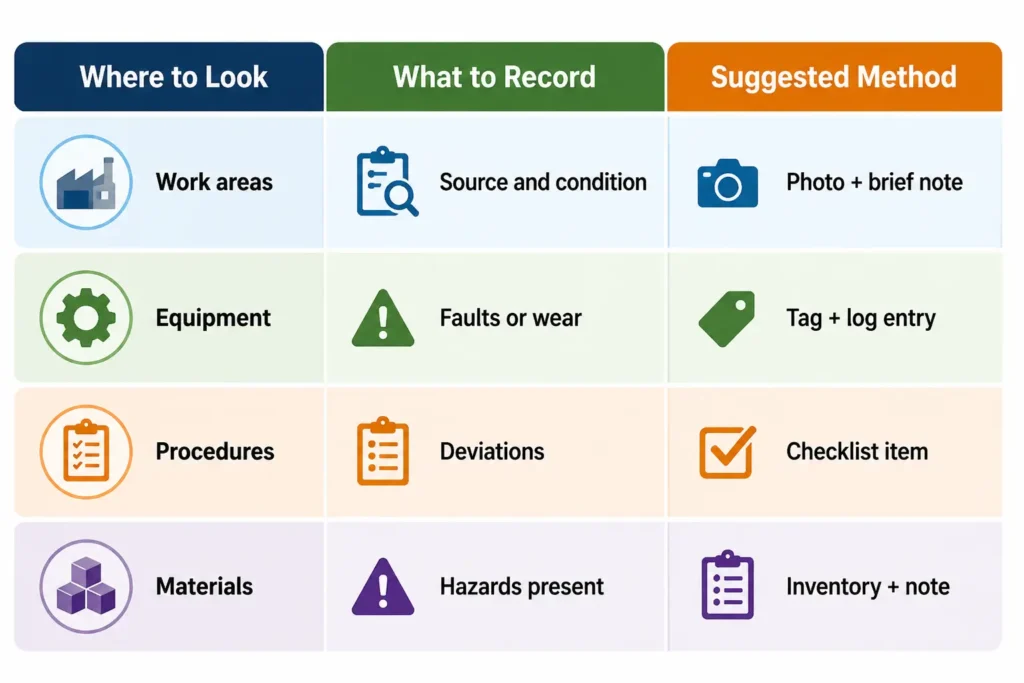
Step 1 – Identify Hazards: Where to Look and How to Record Them
After seeking a simple framework, users must begin by finding what could cause harm: identifying hazards. The approach focuses on places to look at physical spaces, processes, equipment, and materials and on practical recording: concise notes, photos, and standardised logs. The tone values autonomy: empower individuals to observe freely, document clearly, and prioritise actionable information. Identification stays objective, avoiding assumptions about who or how harm occurs, reserving that for the next step. Entries should capture cause, location, and conditions and be accessible for review. Use checklists, incident reports, and digital forms to maintain traceable records while allowing flexible methods that suit different settings.
Step 2: Identify Who/What Is at Risk and How Harm Happens
Step 2 maps who or what could be harmed and traces how that harm might occur, linking identified hazards to specific people, roles, groups, assets, and environments. The process catalogs affected parties, employees, contractors, visitors, vulnerable populations, critical systems, and physical assets and describes exposure pathways and mechanisms of injury, loss, or degradation. It considers routine tasks, exceptional operations, and environmental conditions that enable harm, noting proximity, frequency, duration, and existing protections. Attention extends to interdependencies: how one failure propagates to others, how shared spaces concentrate risk, and how marginalised or mobile groups face amplified consequences. Documentation distinguishes direct from indirect impacts and records assumptions and information sources. The outcome is a clear, actionable map showing who or what stands to lose and by what means, empowering decision-makers to respect autonomy, allocate safeguards, and target controls that preserve freedom while reducing avoidable harm.
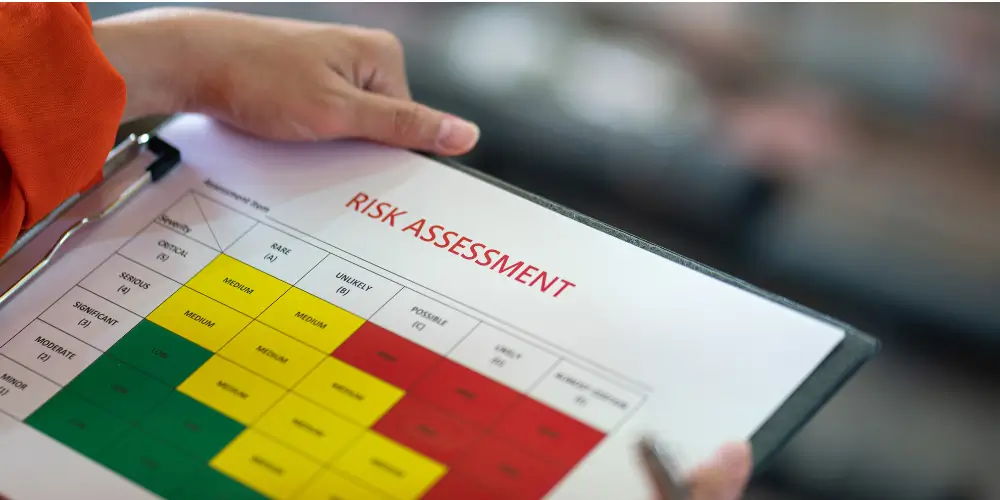
Step 3: Evaluate and Prioritise Risks (Likelihood × Severity, Risk Matrix)
Begin by converting identified risks and affected parties into quantifiable risk estimates that combine likelihood and severity. The evaluator assigns probabilities and consequence levels, then multiplies or maps them on a risk matrix to produce a ranked view. This process clarifies which exposures most constrain operational freedom and where resources should be focused. It remains neutral: no controls are chosen yet, only prioritisation.
- Rate likelihood (rare to almost certain) with clear criteria.
- Rate severity (insignificant to catastrophic) is tied to real impacts.
- Multiply or locate each risk on a matrix to derive risk scores.
- Rank risks and note uncertainties or data gaps.
Prioritisation balances tolerability and the desire to preserve autonomy, highlighting high-score hazards that limit options. Documented scores, assumptions, and review triggers enable revisiting priorities as conditions change or new information emerges.
Step 4: Choose and Implement Controls (Hierarchy of Controls, Examples)
With prioritised risks and documented assumptions in hand, the assessment moves to selecting and applying measures that reduce likelihood and/or severity according to a standard hierarchy of controls. The hierarchy favors elimination of risk first, substitution next, then engineering controls, administrative controls, and finally personal protective equipment. Implementers choose controls that maximise effectiveness while preserving autonomy and operational flexibility. Elimination might redesign a process to remove a risk; substitution could replace a hazardous material with a safer one. Engineering controls isolate people from hazards through barriers, ventilation, or automated systems. Administrative controls adjust behaviors and procedures, training, signage, and shift rotation without imposing undue restrictions. Personal protective equipment (PPE) serves as a last-resort barrier when higher-level options are impractical. Examples should be tailored to context, cost, and residual risk tolerances, with clear assignment of responsibilities and timelines for implementation. Decisions balance risk reduction, resource constraints, and individuals’ preference for control over their work environment.
Step 5: Monitor, Review, and Update; When to Re-Assess
Establish a continuous cycle of monitoring, review, and updating to guarantee controls remain effective and risks do not drift back to unacceptable levels. The process emphasises vigilance and autonomy: records of incidents, performance metrics, and stakeholder feedback are examined regularly to confirm controls perform as intended. Re-assessment triggers include operational changes, near misses, regulatory updates, and evolving threats; timely action preserves freedom to operate without undue constraint.
- Schedule periodic reviews based on risk severity and operational tempo.
- Capture measurable indicators and qualitative reports for each control.
- Re-assess after any change to processes, personnel, technology, or environment.
- Escalate immediate re-evaluation when incidents, audits, or compliance shifts occur.
This step frames risk management as an adaptive practice that empowers decision-makers. Independence is maintained by clear reassessment criteria, concise documentation, and rapid feedback loops that allow organisations to adjust controls proportionately and resume normal activity with confidence. If you are a landlord, you need to read the blog post A Landlord’s Guide to Fire Risk Assessments in London: Legal Duties and Best Practices.
Common Pitfalls and a Usable Risk Assessment Checklist
Awareness of common pitfalls sharpens the effectiveness of any risk assessment: oversights such as vague scope, inconsistent criteria, or reliance on outdated data systematically undermine outcomes. The detached observer notes recurring errors: failure to involve stakeholders, neglecting to validate assumptions, inadequate documentation, and insufficient reassessment cadence. These mistakes constrain agility and erode trust, limiting decision-makers’ freedom to act.
A usable checklist counters those risks with clear, actionable items: define scope and objectives; identify stakeholders and assign roles; list hazards and sources of evidence; set consistent likelihood and impact criteria; estimate risk and prioritise; document assumptions and uncertainties; select controls and assign owners; plan monitoring, review intervals, and trigger conditions; validate data and methods; and archive reports with version control. Regularly revisiting the checklist preserves relevance and enables adaptive responses. Applied consistently, the checklist frees teams to manage risk decisively without bureaucratic drag. Everyone needs Understanding Fire Risk Assessment Checklists and Why They Matter.
Frequently Asked Questions
How Do I Quantify Residual Risk After Controls Are Applied?
They quantify residual risk by recalculating likelihood and impact after controls, converting to a numeric score or rating, then comparing to tolerance. The evaluator freely adjusts assumptions, documents uncertainty, and monitors effectiveness continuously.
Can Risk Assessment Be Automated With Software Tools?
Yes, automation is feasible; the individual employs software to aggregate assets, apply threat models, calculate likelihood and impact, and monitor residual risk continuously, preserving transparency and configurability while avoiding rigid, centralised constraints.
How Do Legal/Regulatory Requirements Affect Risk Prioritisation?
Legal and regulatory requirements shape priorities by imposing mandatory controls, deadlines, and acceptable risk thresholds; they constrain discretionary choices, elevate compliance-related risks, and force organisations to allocate resources to satisfy statutes while preserving operational autonomy.
What Level of Documentation Is Legally Sufficient for Audits?
Legally sufficient documentation typically includes clear, contemporaneous records demonstrating compliance, decisions, controls, and evidence of implementation; it must be auditable, retained per law, reasonably detailed, and accessible, enabling reviewers to independently verify adherence and accountability.
How Often Should Risk Assessments Be Externally Reviewed?
Annually, with more frequent reviews after major changes or incidents, an independent external review every one to three years balances assurance and liberty, allowing organisations to adjust controls while preserving operational freedom and accountability.
Conclusion
In conclusion, What Are the Five Steps to Risk Assessment explains how the process identifies risk, determines who or what is at risk and how harm may occur, evaluates and prioritises risks, implements appropriate controls, and monitors and reviews outcomes. This provides a clear, systematic approach to managing workplace and operational risks. Routine reassessment, attention to common pitfalls, and the use of a practical checklist help maintain effectiveness. Consistent application of these steps supports safer decisions, reduces harm, and promotes continuous improvement in risk management. Explore the 4 types of fire risk assessment as each type serves a different purpose.