A workplace risk assessment systematically identifies hazards, assesses their likelihood and severity, and ranks risks to guide control measures. It sets a clear scope, involves managers, supervisors, safety experts and frontline staff, and uses inspections, incident records and worker feedback to spot hazards. For each hazard, it records who might be harmed, estimates risk, selects practical, proportionate controls, and then assigns responsibilities and review dates. Documentation and regular reviews keep controls effective, and the following sections explain how to apply these steps in practice.
Key Takeaways
- Define the assessment scope: set locations, tasks, people affected, and timeframes before beginning inspections.
- Identify hazards by surveying workplaces, reviewing incidents, consulting workers, and using photos or checklists.
- Evaluate each hazard by estimating likelihood and severity, noting existing controls and residual risk.
- Prioritize risks and select practical controls that reduce risk to acceptable levels with assigned owners and deadlines.
- Implement, monitor, and review controls regularly, documenting changes and learning from incidents for continuous improvement.
Table of Contents
Why Do a Workplace Risk Assessment?
Identify hazards and evaluate their likelihood and consequences to protect employees, assets, and operations. A workplace risk assessment clarifies where threats exist and how they might interrupt work, enabling intentional choices rather than reactive measures. It empowers teams to prioritise interventions that preserve individual autonomy and operational continuity, aligning safety with the freedom to work without undue constraint. By quantifying risk, decision-makers allocate resources where impact is greatest, reducing unnecessary controls that limit initiative.
Documentation of findings creates transparency and accountability, supporting informed consent among staff and clear expectations for managers. Regular review embeds adaptability, so protections evolve with new conditions instead of imposing rigid rules. Ultimately, assessment converts uncertainty into manageable options: accept, mitigate, transfer, or eliminate risks. This process respects employees’ capacity for responsible action while safeguarding assets and reputation, fostering a workplace where liberty coexists with prudent stewardship. Here are the Effective Fire Risk Strategies for Commercial Spaces Every Business Should Know.

Quick 6‑Step Workplace Risk Assessment Checklist
A concise, six-step checklist guides a practical workplace risk assessment from hazard recognition to review, ensuring each stage, scope, hazard identification, risk evaluation, control selection, implementation, and monitoring is completed in sequence and documented for accountability.
The checklist offers a compact framework that empowers teams to act deliberately, preserve operational freedom, and reduce harm.
- Define scope: set boundaries, tasks, locations, and assessment limits.
- Identify hazards: observe, list, and record potential sources of harm.
- Evaluate risks: estimate likelihood and severity, prioritize issues.
- Select controls: choose measures that reduce risk to acceptable levels.
- Implement: assign actions, set timelines, document changes.
- Monitor and review: verify effectiveness, update when conditions change.
Emphasis stays on clarity and autonomy: the checklist enables independent judgment within defined steps, encourages pragmatic choices, and insists on documentation to maintain traceability. It avoids prescriptive rigidity, favoring adaptable controls suited to varied workplaces. Check the detailed guidance on Fire Risk Assessment Checklists and Why They Matter.
Who to Involve and What Each Role Does
Involving the right people guarantees assessments are accurate, practical, and accepted. This includes senior management for authority and resources, supervisors for operational insight, frontline workers for firsthand hazard knowledge, safety professionals for technical guidance, and, where relevant, contractors and health specialists for specialised risks.
Each role has clear responsibilities: senior management sets scope, allocates budget, and enforces outcomes; supervisors coordinate schedules, implement controls, and verify procedures; frontline workers report hazards, test controls, and suggest pragmatic fixes; safety professionals design assessment methods, evaluate risks, and recommend mitigation based on standards; contractors supply specifics on outsourced activities and confirm compliance; health specialists assess exposure, medical implications, and monitoring needs.
Participation should be voluntary but encouraged, with communication channels that respect autonomy and practical input. Documentation responsibilities are assigned to a designated coordinator who consolidates findings, tracks corrective actions, and guarantees follow-through. This structure balances authority, expertise, and lived experience to produce actionable, accepted risk-control plans. Find out what GOV.UK says about the responsible person for fire safety.
How to Identify Hazards: Practical Walkthrough
Begin by surveying the workplace systematically to spot anything that could cause harm, focusing on tasks, equipment, materials, environment, and work organisation. The observer notes visible risks, listens to workers, and reviews records of incidents and near misses. Photographs and simple sketches capture contexts; checklists guarantee consistency. Consider routines and irregular activities alike, and prioritise hazards that limit autonomy or safety freedom.
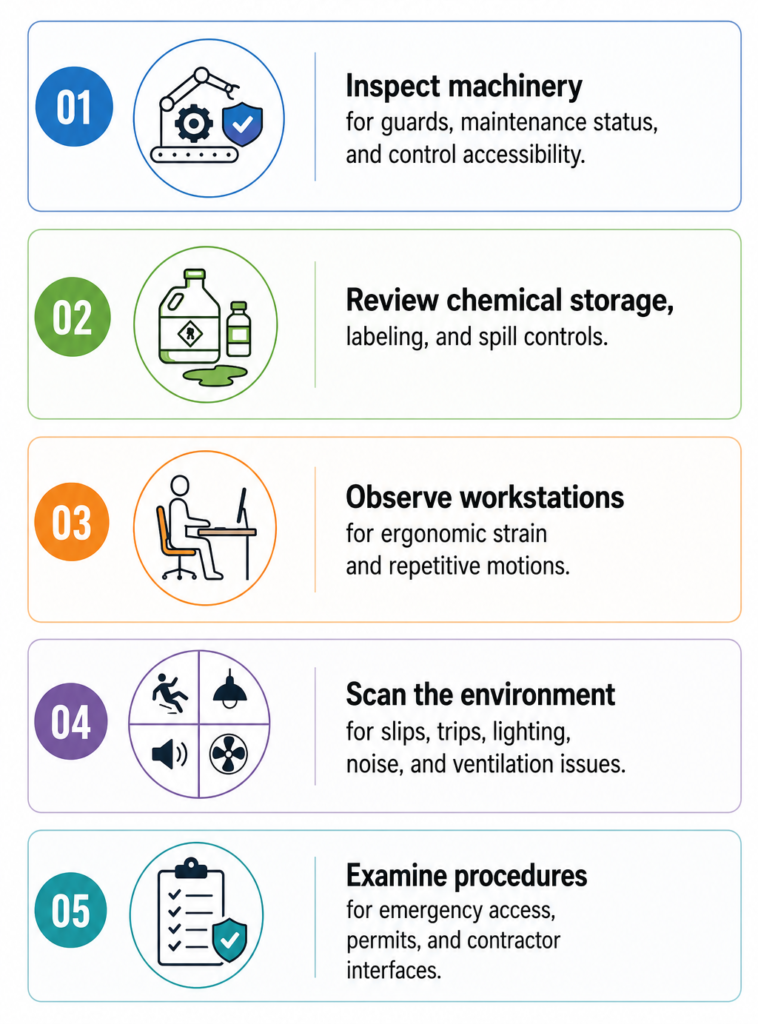
This practical walkthrough delivers a clear inventory of potential harms without assigning blame. Findings are documented succinctly, enabling informed decisions on controls that preserve worker independence and practical safety measures.
Identify Who May Be Harmed and How They Could Be Injured
One group at a time should be listed and matched to specific tasks so the assessor can clearly see who might be harmed and by what mechanism. The assessor catalogs employees, contractors, visitors, and vulnerable persons (young, pregnant, disabled) against each hazard identified. For every pairing, the likely injury or health effect is recorded cuts, falls, chemical exposure, musculoskeletal strain, hearing loss, or stress-related conditions. Consider frequency and duration: brief exposure vs. repeated tasks.
Note atypical situations: maintenance, cleaning, emergency response, and shift work. Include people off-site affected by workplace activities, such as delivery drivers or neighbors. Use clear, neutral descriptors rather than labels that restrict access or opportunity. Evidence such as incident logs, medical reports, and worker feedback supports accurate identification. This mapping creates a concise reference that informs appropriate protective actions while respecting individuals’ autonomy and role diversity.
Evaluate Risk and Prioritise Controls
Assessors next quantify the likelihood and severity of harm for each identified hazard to determine which risks demand prompt action. They assign simple ratings or categories, balancing probability and consequence to create a clear risk profile. This enables decisive prioritisation while preserving operational flexibility.
Key considerations include control effectiveness, cost, legal obligations, and the rights of individuals to operate without undue restriction.
- Rank risks by combining likelihood and severity into a single score or tier.
- Review existing measures and note gaps that allow residual risk.
- Prioritise controls that reduce the highest scores first, preserving essential freedom where possible.
- Consider practicability and proportionality to avoid excessive constraints.
- Set timelines for action, monitoring, and reassessment.
The outcome is a ranked action plan: targeted interventions for top risks, lower-level monitoring for minor issues, and a commitment to reassess when operations or hazards change.
Practical Controls for Offices, Shops and Sites
With high-priority risks identified and scheduled for action, attention shifts to practical controls tailored to offices, shops and sites. Implementers focus on controls that reduce risk while preserving autonomy: ergonomic workstations and adjustable seating to prevent musculoskeletal strain; clear pedestrian routes, anti-slip flooring and adequate lighting to minimise trips; visible signage and unobstructed exits for quick egress; secure shelving and safe storage to prevent falling objects; simple lockout/tagout procedures for equipment, scaled to the environment; routine cleaning schedules and waste management to limit contamination; access control and CCTV proportionate to threat levels, balancing security with privacy.
Controls favor user-friendly solutions that staff can adopt without heavy oversight. Training is concise, practical and voluntary in tone, enabling informed choices. Regular maintenance schedules and easy-to-follow checklists guarantee controls remain effective. Each measure aligns with business needs, striking a balance between safety and the freedom to work productively.

Record, Review, and Avoid Common Pitfalls
Documenting decisions and evidence guarantees that risk assessments remain useful over time: clear records capture what hazards were identified, why controls were chosen, who is responsible, and when actions must be completed.
The record becomes a living map for those who value autonomy, enabling independent judgment and timely updates. Regular review cycles test assumptions, measure control effectiveness, and free teams from repeating mistakes. Attention to common pitfalls preserves energy and trust.
- Record dates, findings, and rationales concisely for future reference.
- Review schedules should be proportional to risk and practical to maintain.
- Assign clear ownership to avoid diffusion of responsibility.
- Avoid overcomplication; prefer usable controls over perfect but unusable plans.
- Capture lessons learned and apply them to future assessments.
This approach balances structure with freedom: documented clarity supports decentralized action, reviews maintain relevance, and avoiding predictable errors keeps efforts focused and sustainable.
Frequently Asked Questions
How Long Should a Full Workplace Risk Assessment Take?
A full workplace risk assessment typically takes several hours to a few days, depending on complexity and size; the assessor moves independently, prioritizes key freedoms and hazards, and documents outcomes efficiently to enable informed, autonomous safety decisions.
Do I Need to Involve External Consultants for Legal Compliance?
External consultants aren’t always required for legal compliance; the individual or organization may assess capabilities, laws, and risks and choose external expertise when complexity, limited internal resources, or specialised regulations threaten autonomy or thorough, defensible compliance.
How Do I Assess Psychosocial or Mental Health Risks?
They identify psychosocial hazards, gather anonymous employee feedback, observe workload and interactions, assess risk likelihood and impact, consult policies and experts if desired, prioritize interventions, implement supportive controls, and monitor outcomes to respect individual autonomy.
Can Risk Assessments Be Used as Evidence in Legal Disputes?
Yes. They can serve as admissible evidence showing foreseeability, mitigation efforts, or negligence; however, their weight depends on quality, timing, documentation, and legal standards, so independent verification and clear records strengthen their probative value.
How Often Should Training Refreshers Be Conducted for Staff?
Refresher training should occur at least annually, with additional sessions following incidents, procedural changes, or when staff demonstrate gaps. This schedule respects individual autonomy while maintaining collective safety and operational freedom.
Conclusion
A concise workplace risk assessment protects people, assets and operations by systematically identifying hazards, evaluating risks and implementing controls. Involving managers, safety specialists and employees guarantees practical perspectives and legal compliance. Prioritised, proportionate measures, engineering, administrative and PPE reduce the likelihood and severity of harm across offices, shops and sites. Clear records, regular reviews, and corrective action sustain effectiveness and prevent recurring mistakes. Consistent application turns assessment into continuous, evidence‑based risk control and safer daily practice.