Maintained emergency lighting stays on at all times, acting as normal lighting and switching to battery power during a mains failure. Non-maintained emergency lighting remains off in normal conditions and only comes on when the power fails. Maintained systems suit busy public areas needing constant illumination, while non-maintained options save energy in spaces with existing lighting. Both types must support visible escape routes and comply with standards like BS 5266-1, and the practical differences become clearer with further detail.
Key Takeaways
- Maintained emergency lighting is on all the time, acting as normal lighting and switching to battery when mains power fails.
- Non-maintained emergency lighting stays off in normal conditions and automatically turns on only during a mains power failure.
- Maintained systems suit occupied public areas (e.g., theatres, corridors) where continuous illumination and visual familiarity are important.
- Non-maintained systems are ideal for plant rooms, storage areas, or spaces with good normal lighting, reducing energy use and visual clutter.
- Both types must be tested and maintained regularly to meet standards (e.g., BS 5266-1, BS EN 1838) and ensure safe escape lighting.
Table of Contents
Maintained vs Non-Maintained: What’s the Difference?
How do maintained and non-maintained emergency lights actually differ in day-to-day operation? For anyone who values the freedom to move, gather, and work on their own terms, the distinction shapes how spaces feel and function.
Maintained fittings stay illuminated during normal conditions, acting as regular lighting while still ready for power loss. Non-maintained fittings stay off and come to life only when the main supply fails. Maintained systems suit venues that welcome people at all hours bars, studios, co-working hubs where consistent lighting supports fluid, unbroken activity.
Non-maintained options appeal where routine lighting is already abundant, and owners want leaner energy use and less visual clutter. In practice, the difference affects ambience, running costs, and the visibility of escape routes as crowds build. Choosing between them is less about regulation lists and more about shaping a space that remains open, navigable, and safe when the unexpected happens.

How Maintained Emergency Lighting Works
Rather than switching roles when the power fails, maintained emergency lighting runs continuously as part of the normal lighting scheme and simply changes mode during an outage.
Each fitting operates as a standard light under normal conditions, powered from the mains and typically controlled by regular switches or lighting controls, providing building users with predictable, unrestricted illumination. Inside the luminaire, an automatic charge controller keeps the internal battery topped up whenever mains power is available.
A changeover circuit constantly monitors the supply. When it detects a failure or voltage drop below a set threshold, it transfers the load from the mains to the battery in a fraction of a second. The lamp stays lit, but at a pre‑defined emergency output, preserving battery life while still marking escape routes and critical areas. When mains power returns, the system recharges the battery and returns the fitting to normal operation without user intervention.
How Non-Maintained Emergency Lighting Works
In contrast to maintained fittings that operate during both normal and emergency conditions, non‑maintained emergency lighting stays off in everyday use and activates only when the mains supply fails.
Each unit contains a standard light source, a dedicated emergency driver or inverter, and a rechargeable battery that is kept charged while power flows freely. When the mains is present, the circuit simply charges the battery and monitors its status, leaving the space free from unnecessary glare or visual clutter.
The moment power is cut, an internal relay or control unit senses the loss and instantly shifts the load to the battery, illuminating escape routes, exits, or high‑risk areas. This automatic change happens without user input, preserving autonomy for occupants and building operators.
Once mains power returns, the fitting reverts to standby mode, the battery recharges, and the environment resumes its normal, unlit state until it is genuinely needed again.
Maintained vs Non-Maintained: Key Differences at a Glance
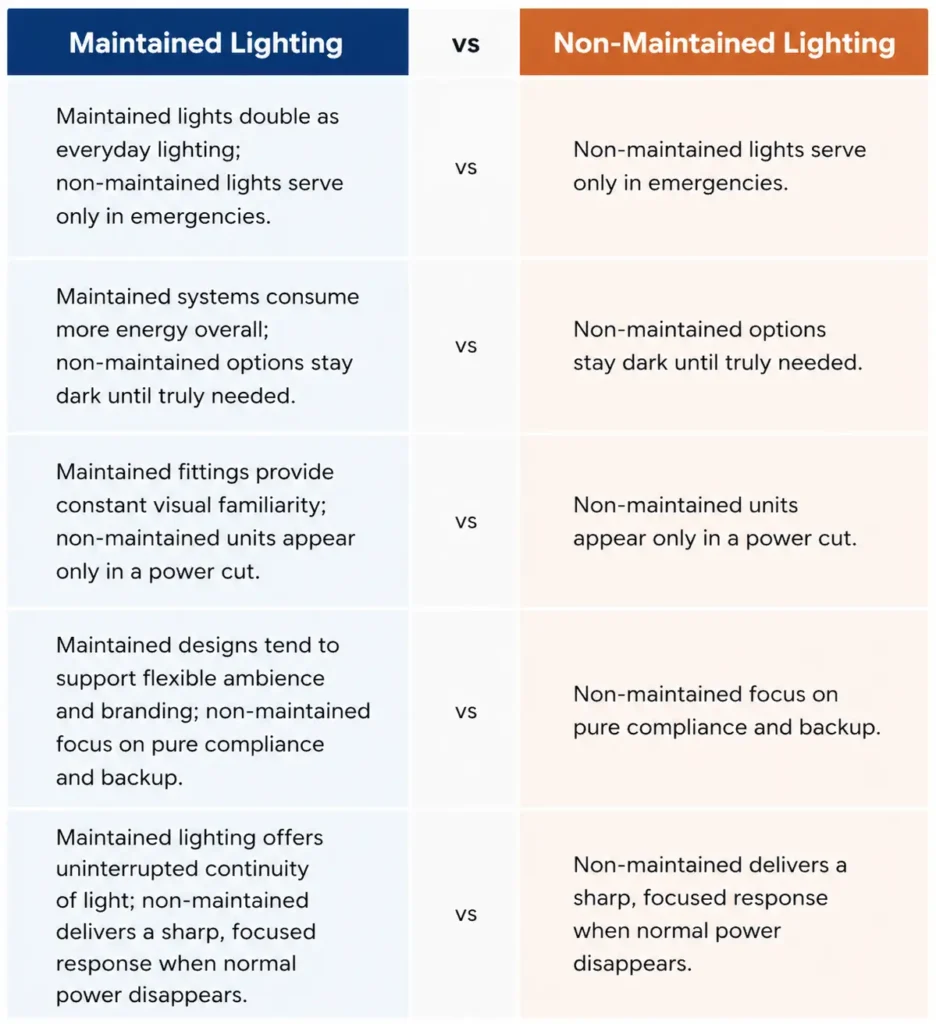
At a glance, the distinction between maintained and non‑maintained emergency lighting revolves around when and how each type operates. Maintained fittings stay illuminated during normal conditions and automatically switch to battery power during an outage. Non‑maintained fittings remain off in everyday use and activate only when the mains supply fails.
For those who value autonomy and clear choices, the differences can be summarised as follows:
Where to Use Each Type in Your Building
Location dictates the most effective use of maintained and non‑maintained emergency lighting throughout a building. In busy public areas where people gather, maintained fittings keep escape routes visible at all times, supporting spontaneous movement and independent wayfinding. Corridors, lobbies, and assembly points benefit from constant illumination that feels natural rather than restrictive.
By contrast, non‑maintained lights suit spaces used less frequently or only by informed staff, where darkness is acceptable during normal operation but rapid guidance is essential during power loss.
| Area Type | Recommended Emergency Lighting Type |
| Theatres, bars, leisure hubs | Maintained |
| Entrance halls, key corridors | Maintained |
| Plant rooms, storage areas | Non‑maintained |
| Small offices, back‑of‑house | Non‑maintained |
Designers can mix both types to keep circulation routes clear without over‑controlling every corner of the building, giving occupants well‑lit choices while keeping the system lean, responsive, and focused on real escape needs.
UK Rules for Maintained and Non-Maintained Lighting
Although building owners have flexibility in how they illuminate escape routes, UK legislation and standards set clear expectations for when maintained or non‑maintained emergency lighting must be used.
The Regulatory Reform (Fire Safety) Order 2005 places responsibility on the “responsible person” to ensure escape lighting is in place whenever people are in the building.
BS 5266‑1 and BS EN 1838, then translate that duty into practical rules.
- Maintained fittings are expected in places where people rely on constant light: cinemas, theatres, bars, and assembly spaces.
- Non‑maintained fittings are generally acceptable in offices and similar workplaces with reliable general lighting.
- All escape routes, open areas, and high‑risk task zones must meet the minimum illuminance levels set out in BS EN 1838.
- Systems must be tested regularly, with results recorded and defects fixed without delay.
- Any change of layout, use, or occupancy requires a fresh fire‑risk assessment to confirm compliance.
How to Choose the Right Emergency Lighting Setup
Choosing the right emergency lighting setup starts with understanding how the building is used, who occupies it, and how they escape in an emergency. An assessment of hours of operation, public access, and sleeping risk quickly indicates where maintained, non‑maintained, or combined systems best protect people’s freedom of movement.
Maintained fittings typically suit spaces open to the public bars, galleries, venues where a steady visual baseline supports confident evacuation in the event of power failure. Non‑maintained fittings fit workplaces or storage areas that are normally lit, activating only when the supply drops, keeping energy use lean without sacrificing safety.
Designers then map escape routes, high‑risk zones, and open areas, ensuring signage and illumination levels meet legal standards while still respecting flexible layouts. They consider wiring, testing access, and battery autonomy, and choose self‑test or central-test options to minimise disruption.
The right mix gives occupants clear, independent routes out without over‑lighting or over‑regulating the space.
Frequently Asked Questions
Can Emergency Lighting Double as Architectural or Feature Lighting in Design-Led Spaces?
Yes, emergency lighting can double as architectural or feature lighting in design-led spaces.
Designers often choose maintained fittings that stay on, blending safety with creative expression. Slim profiles, concealed details, and sculptural forms let people enjoy visual freedom without clashing with regulations.
Dimmable and colour‑tunable options can support mood and brand identity, provided spacing, output, and escape‑route requirements remain fully compliant.
How Often Should Emergency Lighting Batteries Be Replaced for Optimal Reliability?
Emergency lighting batteries should be replaced every 3–4 years for optimal reliability, even if they appear to be working.
A freedom‑minded designer or building owner treats them like a safety parachute: regularly tested monthly and annually, then swapped before they age out.
Local codes, manufacturer guidance, ambient temperature, and frequency of discharge tests may justify earlier replacement, ensuring occupants can move and exit independently when the normal power supply fails.
What Testing Records for Emergency Lighting Must Be Kept for Compliance Inspections?
They must keep records of every emergency lighting test, including monthly function checks and annual full-duration tests, with dates, locations, results, and any defects.
Logs must also show corrective actions, repairs, and battery or fitting replacements, signed by the responsible person or contractor.
Records can be paper or digital, but must be secure, up to date, and easily accessible to fire authorities and safety inspectors who demand proof of ongoing compliance.
How Do Emergency Lighting Requirements Change During Building Refurbishment or Change of Use?
Emergency lighting requirements usually tighten during refurbishment or change of use.
The designer must re‑assess occupancy, escape routes, and risk profile, then upgrade luminaires, coverage, and duration to current standards, not the building’s original rules. Layout changes, added rooms, or higher public use often trigger extra exit signs, higher illuminance, and more robust testing access.
Authorities may demand a full new design, updated logbooks, and certification before the space can be freely reoccupied.
Are There Specific Emergency Lighting Considerations for Listed or Heritage Buildings?
Yes. Listed and heritage buildings demand emergency lighting that protects life without violating character.
Designers must respect fabric, sightlines and original finishes, often using reversible fixings, wireless controls, and discreet luminaires.
Any intervention usually requires consent from conservation officers. They must still meet contemporary codes for lux levels, escape routes and duration, but achieve this with minimal visual impact, careful colour temperature, and sympathetic placement that preserves historic freedom of experience.
Conclusion
In conclusion, understanding the difference between maintained and non-maintained emergency lighting helps guarantee safety, compliance, and practicality in any building. Maintained systems offer constant illumination where needed, while non-maintained units provide backup only during power loss. By matching each type to the appropriate space and adhering to UK regulations, building owners can create a clear, reliable escape route strategy and choose an emergency lighting setup that protects occupants and meets legal obligations.