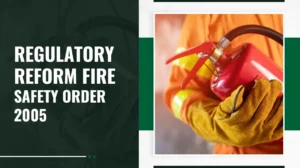
The Regulatory Reform (Fire Safety) Order 2005 is the main fire safety law for non-domestic premises in England and Wales, including workplaces and shared parts of residential buildings. It places duties on the “responsible person” (often the employer, owner, or landlord) to carry out a suitable fire risk assessment and maintain effective precautions. This includes safe escape routes, alarms, signage, training, and ongoing maintenance. Enforcement is carried out by fire and rescue authorities, with notices and prosecutions for serious breaches. Further details are provided on duties, assessments, and checks.
Key Takeaways
- The Regulatory Reform Fire Safety Order 2005 is the main fire safety law for most non-domestic premises in England and Wales, including workplaces and the shared parts of residential buildings.
- The law places duties on the responsible person, usually the employer, owner, landlord, managing agent, or another person with control of the premises.
- A suitable and sufficient fire risk assessment is the foundation of compliance. It should identify hazards, people at risk, current precautions, and any further action needed.
- Fire precautions must be practical and effective. This includes safe escape routes, fire alarms, emergency lighting, signage, firefighting equipment, staff training, and ongoing maintenance.
- Fire safety is not a one time task. Checks, testing, servicing, record keeping, and regular reviews are needed to make sure precautions remain effective.
- In multi occupied buildings, dutyholders must cooperate and coordinate so that fire safety responsibilities are clear and shared risks are properly managed
Table of Contents
Does the Fire Safety Order Apply to You?
Where does the Regulatory Reform (Fire Safety) Order 2005 apply?
It applies across England and Wales to most non-domestic premises, including workplaces, shops, offices, factories, warehouses, hotels, care homes, schools, and public buildings. It can also cover the shared parts of residential buildings, such as corridors, stairwells, entrance halls, and plant rooms, where multiple households use common areas. Whether it applies depends less on business size and more on how the premises are used.
Any place where employees work, the public is admitted, or people sleep for short stays is likely in scope. The person who controls the premises, such as an employer, owner, landlord, managing agent, or facilities manager, is usually the “responsible person” for compliance. If unsure, the safest assumption is that it applies unless the premises are a private single dwelling.
What Is the Fire Safety Order 2005?
The Regulatory Reform (Fire Safety) Order 2005 is the core legal framework for fire safety in non-domestic premises in England and Wales. It replaced much of the older, certificate-based regime with a risk-based approach that focuses on prevention, protection, and ongoing management rather than one-off approval.
Under the Order, fire safety is treated as a continuous duty to assess hazards, reduce risk, and maintain effective safeguards. It sets expectations for suitable fire risk assessments, proportionate control measures, and clear emergency arrangements. Compliance is enforced by fire and rescue authorities, which may inspect premises and take action where serious shortcomings are found.
Key features include:
- Risk assessment is the starting point for decisions.
- Practical measures such as detection, alarms, escape routes, and signage.
- Maintenance, testing, and record-keeping to prove controls work.
- Enforcement powers, including the ability to issue notices and prosecute breaches.
Who Is the “Responsible Person” Under the Fire Safety Order?
Although day-to-day fire safety tasks can be delegated, legal responsibility under the Fire Safety Order rests with the “responsible person”: typically the employer for workplace premises, or otherwise the person who has control of the premises in connection with a trade, business, or other undertaking (such as an owner, managing agent, or facilities manager).
This definition focuses on practical control: who directs how the building is used, maintained, and managed.
In multi-occupied buildings, there may be more than one responsible person. Each dutyholder is accountable for the parts of the premises under their control, including shared areas where they exercise control. Contractors and service providers may be appointed to carry out fire safety functions, but such appointments do not transfer liability.
Where control is split or unclear, cooperation and coordination are expected so that responsibilities do not fall between organisations .Identifying the responsible person is the starting point for compliance and effective enforcement by authorities.
What Must a Fire Safety Order Risk Assessment Include?
To comply with the Regulatory Reform (Fire Safety) Order 2005, a fire risk assessment must identify fire hazards, determine who may be harmed and how, and evaluate whether existing precautions are adequate to reduce risk to an acceptable level.
It should be systematic, proportionate to the premises, and based on how the building is actually used, including normal operations and foreseeable non-routine activities.
- Premises profile: layout, construction features, processes, occupancy levels, and higher-risk areas.
- Hazard and ignition sources: fuels, heat sources, oxygen supply, and how they could combine.
- People at risk: employees, residents, visitors, contractors, and vulnerable individuals, noting times and locations of exposure.
- Findings and controls review: evidence of current measures, remaining risk rating, required actions, responsible parties, and target dates.
The assessment should be recorded where required, kept current, and reviewed after a significant change, incident, or near miss.
What Fire Precautions Does the Fire Safety Order Require?
Prevention sits at the heart of the Regulatory Reform (Fire Safety) Order 2005, which requires the responsible person to implement “general fire precautions” that reduce the likelihood of fire and limit harm if one occurs.
These precautions include safe routes to emergency exits, clear signage, suitable emergency lighting, and keeping escape routes unobstructed and quickly openable. The Order also expects appropriate fire detection and warning arrangements, such as alarms that can be heard throughout the premises.
Suitable firefighting equipment must be provided, typically including extinguishers matched to likely fire types, and maintained so it remains effective. Further precautions cover reducing ignition sources, controlling combustible materials, and managing dangerous substances.
The responsible person must ensure that everyone can evacuate safely, including people at greater risk, and that staff receive relevant information, instructions, and training. Where needed, cooperation and coordination with other occupiers, contractors, or building managers are part of the required precautions.
How Often Should Fire Safety Order Checks Be Done?
Once suitable fire precautions are in place, the Fire Safety Order expects them to be checked often enough to remain effective, with frequency based on the premises’ risk level and how it is used.
Higher-risk sites (sleeping accommodation, complex layouts, vulnerable occupants, high staff turnover) typically need more frequent checks than low-risk offices with stable occupancy.
- Daily/shift checks: escape routes clear, final exits usable, fire doors not wedged, obvious hazards controlled.
- Weekly checks: test fire alarm call points in rotation; check emergency lighting indicators; confirm extinguisher access.
- Monthly/quarterly checks: inspect fire doors, signage, and evacuation aids; review housekeeping and storage controls.
- Periodic servicing and review: specialist maintenance of alarms, emergency lighting, sprinklers, and extinguishers; refresh the fire risk assessment when layouts, occupancy, processes, or incidents indicate change.
Records should note dates, findings, actions taken, and completion, helping guarantee checks remain systematic and traceable.

How Is the Fire Safety Order Enforced (Inspections and Notices)?
Although the Regulatory Reform (Fire Safety) Order 2005 is primarily risk-based, it is enforced through proactive and reactive oversight by fire and rescue authorities, who can inspect premises, review fire risk assessments and safety records, and require improvements where standards fall short. Inspectors may attend after complaints, incidents, or as part of targeted programmes focusing on higher-risk buildings. During a visit, they typically tour the premises, test management arrangements, and sample evidence such as alarm tests, maintenance certificates, evacuation drills, and training logs.
| Inspection focus | What is typically checked |
| Means of escape | Routes clear, doors functional, signage adequate |
| Fire protection systems | Alarms, lighting, and extinguishers are maintained and tested |
| Management controls | Risk assessment is suitable, and staff roles are understood |
| Records and follow-up | Findings noted, actions agreed, timescales set |
Where shortcomings are identified, authorities can issue formal notices requiring specified actions within defined periods, or agree on an informal action plan. Re-inspection may confirm completion and ongoing compliance.
Common Fire Safety Order Breaches and Penalties
Inspection findings and enforcement notices often reveal recurring failures under the Regulatory Reform (Fire Safety) Order 2005, and these can lead to escalating consequences.
Breaches typically arise when a responsible person cannot demonstrate appropriate controls, maintenance, or staff competence. Common shortcomings include weak risk assessments, ineffective detection, and compromised escape routes. Enforcement action ranges from advice to formal notices, and serious cases may proceed to prosecution, fines, or imprisonment. Penalties often reflect the level of risk, duration of non-compliance, and whether previous warnings were ignored.
- Outdated or generic fire risk assessments that miss hazards, occupancy changes, or vulnerable persons.
- Poorly maintained fire alarms, emergency lighting, or extinguishers, leaving systems unreliable when needed.
- Blocked, locked, or poorly signed escape routes, including defective fire doors and inadequate compartmentation.
- Insufficient staff training and drills, resulting in unclear evacuation roles and delayed response.
Frequently Asked Questions
How Much Does a Professional Fire Risk Assessment Typically Cost?
A professional fire risk assessment typically costs about £200–£1,500, depending on premises size, complexity, location, and assessor qualifications. Small flats or offices are cheaper; large multi-storey buildings and specialist sites cost more.
Do I Need to Keep Digital or Paper Fire Safety Records?
Fire safety records may be kept digitally or on paper; either is acceptable. They should be legible, accessible, and backed up. Digital aids retrieval and sharing; paper suits on-site use. Consistency and secure storage matter.
What Training Should Fire Wardens or Marshals Receive?
Fire wardens should receive training in fire risks, alarm procedures, evacuation management, assisting vulnerable people, extinguisher awareness, checking escape routes, and liaison with responders. Training should be practical, site-specific, regularly refreshed, and documented for accountability.
How Should I Manage Fire Safety in Shared or Multi-Occupied Buildings?
Fire safety in shared buildings should be managed through clear responsibility allocation, coordinated risk assessments, shared emergency plans, maintained alarm systems, controlled ignition sources, regular inspections, resident communication, and joint drills, with documented actions and oversight by competent persons.
Where Can I Find Official Fire Safety Order 2005 Guidance Documents?
Official guidance documents can be found on GOV. In the UK, local fire and rescue service websites that search for fire safety guidance, Approved Documents, and Home Office publications also link to relevant resources and downloadable guides.
Conclusion
The Regulatory Reform (Fire Safety) Order 2005 sets a clear framework for managing fire risk in non-domestic premises, focusing on prevention, protection, and ongoing compliance. It places legal duties on the responsible person to carry out suitable and sufficient risk assessments, maintain fire precautions, and guarantee that staff and occupants can evacuate safely. Enforcement is carried out through inspections and formal notices, with breaches potentially leading to prosecution, significant fines, and imprisonment.